Repair & Troubleshooting
Why your garage door won't open and what to check first
· 12 min read · From the B&B Garage Doors office, Traverse City
When a garage door won't open, check the simple causes first: power to the opener, lock mode on the wall control, the remote battery, a manual lock bar and whether the emergency release was pulled. If the opener hums or strains and the door feels very heavy, a broken spring is the likely cause, and that needs a technician.
Garage door stuck shut right now?
Call the office · Mon to Fri · 7:30 am to 4:00 pm · Free estimates
What should you check first when your garage door won't open
Check the safe, simple things first and in order: the springs from a distance, power, the wall control, the remotes, any manual lock and the emergency release. Many doors that refuse to open have one of these simple causes, and the rest usually trace back to a spring, a cable or the opener itself.
Listen to what the opener does when you press the button. A hum, a click, a motor that runs while nothing moves and total silence each point somewhere different.
- 1Look before you touch anythingFrom the floor, look at the springs above the door and the cables at each bottom corner. If a spring has a gap in the coil or a cable hangs loose, stop here and skip to the spring section below.
- 2Confirm the opener has powerPress the wall button and watch the opener light. If nothing lights up and nothing sounds, check the breaker and any tripped GFCI outlet in the garage.
- 3Check the wall control for lock modeMany wall controls have a lock or vacation setting that blocks every remote. If the wall button works and the remotes don't, this is the first suspect.
- 4Test a second remote or the keypadIf one remote quits and the others work, replace its battery before anything else.
- 5Look for a manual lock on the doorSome doors have a slide bolt on a lower section or a T-handle lock in the middle. If a bar is pushed into the track, the door cannot rise.
- 6Check whether the emergency release was pulledIf someone pulled the red cord during a power outage, the opener can run without moving the door. Reconnect it only with the door fully closed.
What your garage door is telling you when it won't open
The sound the opener makes and the way the door behaves are the fastest way to narrow down the cause. Match what you see and hear in this chart, then read the section that fits.
| What you notice | Likely cause | Safe to check yourself? | Call us? |
|---|---|---|---|
| Brief hum and the door doesn't move | Broken spring or an engaged door lock | Check the lock only | Yes if a spring is broken |
| Motor runs and the door stays put | Opener disconnected from the door or a stripped gear | Yes, with the door closed | If it won't reconnect |
| A click and no movement | Opener part such as a capacitor or logic board | Check power only | Yes |
| Wall button works but the remote doesn't | Lock mode, a dead battery or lost programming | Yes | Rarely |
| No light and no sound at all | No power, a tripped breaker or a GFCI | Yes | If power checks out |
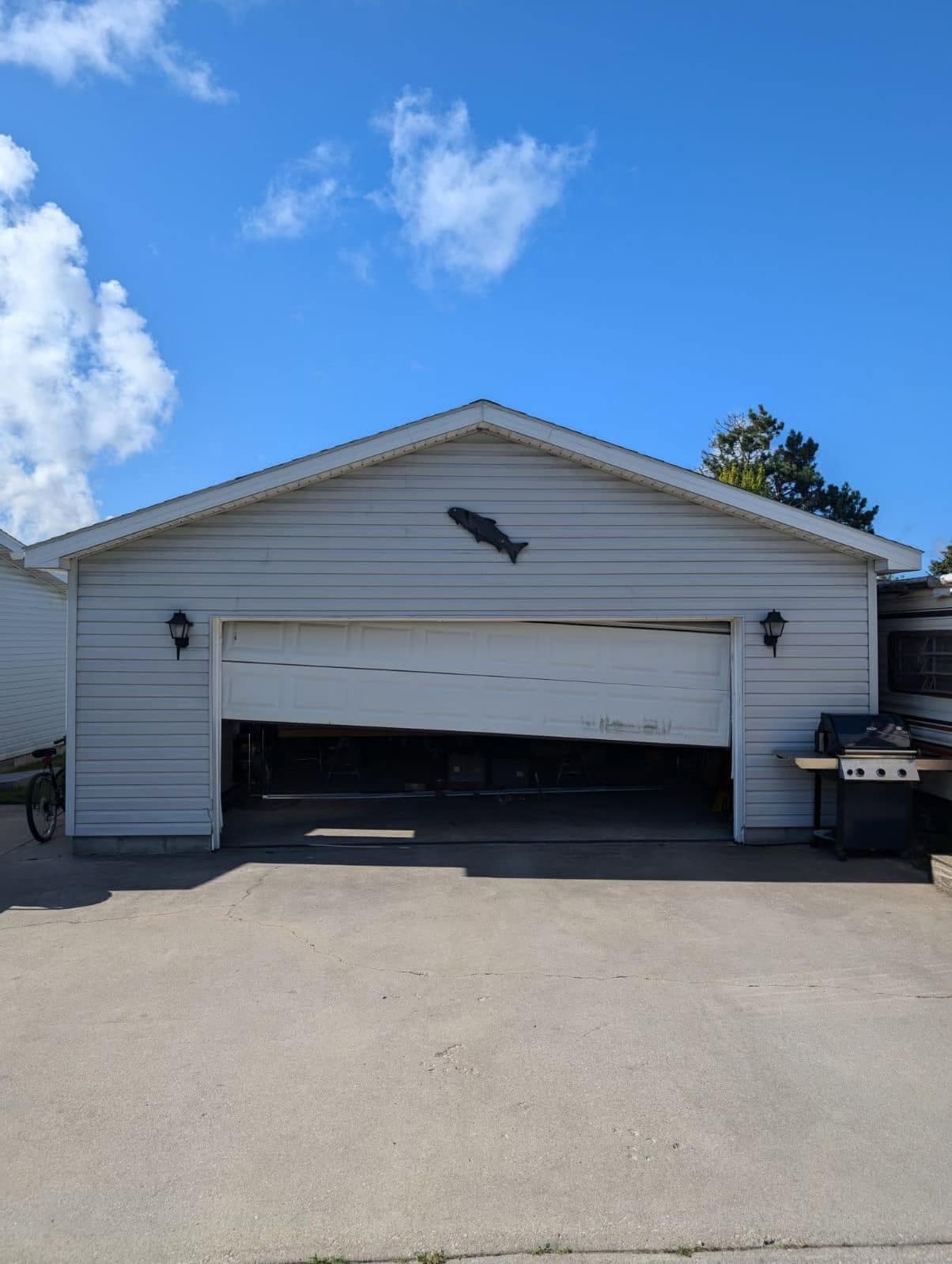
| Door lifts a few inches then stops | Broken spring, frozen seal or a roller out of the track | Look only | Yes |
| A loud bang earlier and the door feels very heavy | Broken torsion spring | No | Yes |
Why won't my garage door open when the opener hums
A brief hum with no movement usually means the motor is trying to lift a door that won't budge, most often because of a broken spring or an engaged door lock. Chamberlain's support guide lists both as the first causes of a short hum on chain and belt drive openers.
Check the lock first. Many older doors have a slide bolt on the inside of a lower section, or a T-handle in the middle that throws bars into the tracks. If a bar is in the track, the opener hums against it. Slide it back and try again.
A hum that keeps going, about 30 seconds according to Chamberlain, usually means the opener is running but the door is not attached to it. A hum on a door that also sits crooked or has a slack cable is a sign to stop pressing the button.
Is a broken spring the reason my garage door won't open
Very often, yes. The springs do the heavy lifting and the opener only guides a door the springs have already balanced, so when a spring breaks the opener hums, strains or lifts the door a few inches and quits.
Look above the door. On a torsion system the spring sits on a shaft over the opening, and a break shows as a gap of a few inches in the coil. Extension springs run alongside the horizontal tracks, and a broken one hangs loose or looks stretched out of shape. Many people also remember a loud bang from the garage earlier.
Clopay's service guide puts typical spring life at around 7 to 12 years depending on how often the door is used, so an older door that runs several times a day is a natural suspect. Replacing springs is work for a technician, and our garage door spring repair page explains what we replace and why we usually do both springs together.
Why does the opener run but the door stays put
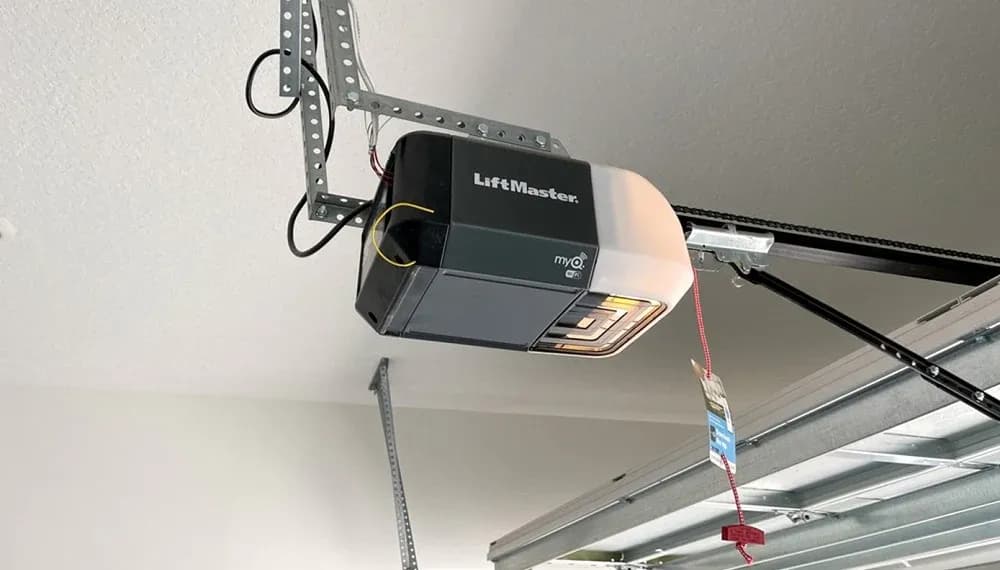
If the motor runs and the chain or belt moves but the door doesn't, the opener is almost always disconnected from the door. This happens when someone pulls the red emergency release during a power outage and nobody reconnects it.
Reconnecting is safe when the door is fully closed. Chamberlain's instructions are to pull the release cord toward the opener so the release arm drops back into place, then run the opener through a full cycle. You should hear the trolley click back in.
If the trolley won't catch, or you hear grinding while the chain or belt moves and the trolley stays put, a drive gear inside the opener may be stripped. That is an opener repair, and on an older unit it is a good moment to weigh the options in our guide on whether to repair or replace a garage door opener.
One firm rule applies to every door: use the manual release only with the door fully closed. Chamberlain warns that if the springs are weak or broken, a door released while open may fall rapidly and without warning.
What does it mean when nothing happens at all
If the opener light stays dark and the motor makes no sound from the wall button or the remote, the opener is probably not getting power. Make sure it is plugged into the ceiling outlet and that the breaker has not tripped.
Garage outlets are usually protected by a GFCI, and the reset button is not always on the outlet the opener uses. It can sit on another outlet on the same circuit, so press reset on every GFCI you can find.
If the power is on and the opener still does nothing, the fault is inside the opener or in the wall control wiring. Unplugging the opener briefly and plugging it back in sometimes clears a confused logic board. If it doesn't, that is a job for garage door opener repair.
Can bad safety sensors keep a garage door from opening
Usually not. The photo-eye sensors near the floor exist to stop a closing door, so blocked or misaligned sensors keep a door from closing, not from opening.
The CPSC standard requires an opener to reverse a closing door within two seconds after it contacts a 2-inch test block, and UL 325 made photo eyes, edge sensors or an equivalent device mandatory in 1993. The CPSC also recommends testing that reversing feature monthly.
So if your door opens but refuses to come back down, or starts down and reverses, look at the sensors first. Wipe the lenses, check that both indicator lights are steady and make sure nothing is in the beam. Checking the sensors and the reversing feature is also part of regular garage door maintenance.
Why won't my garage door open in cold weather
In a hard freeze the usual reasons are a bottom seal frozen to the floor and grease that has stiffened enough to make the opener think the door is blocked.
Meltwater from the car refreezes at the door line and glues the rubber seal to the concrete, so the opener feels resistance and stops. Don't keep pressing the button, which can tear the seal or strain the opener. Free the seal gently with a plastic scraper, then clear the slush so it doesn't refreeze overnight.
Cold also thickens the grease on rollers and hinges. A light spray of garage door lubricant on the rollers and hinges helps. Turning up the opener's force setting to muscle through is not a fix. It makes the door push harder against anything in its way, and Chamberlain says to test the safety reversal after any adjustment.
Long Northern Michigan winters turn this into a yearly routine rather than a one-time problem, from lake cottages to pole barns. If the seal has torn or the door still won't lift once it is free, our crew handles garage door repair in Traverse City and the towns around it.
When should you stop troubleshooting and call a technician
Stop as soon as the problem involves springs, cables, a crooked door or rollers out of the track. Those parts carry the weight of the door, and both DASMA, the door manufacturers' association, and Clopay advise leaving that work to a trained door technician.
- A gap in a torsion spring, or an extension spring that hangs loose or looks stretched.
- A cable hanging slack or unwound from its drum. Our guide on what a snapped or loose cable means explains the risk.
- A door that sits crooked or has rollers out of the track. Read what to do when a door comes off its track before you touch it.
- A door that opens with the opener but feels heavy or drifts when you lift it by hand. Our garage door balance test shows the safe way to check.
- An opener that clicks, grinds or stays dark even with a live outlet.
Sources
- 1.Why does my garage door opener hum but the door does not move? · Chamberlain Group
- 2.Remote Control: Remote Does Not Work · Chamberlain Group
- 3.How to Manually Open or Close a Garage Door · Chamberlain Group
- 4.Safety Commission Proposes Rules for Automatic Garage Door Openers · U.S. Consumer Product Safety Commission
- 5.Automatic Garage Door Standards: Helping to Keep Families Safe · UL Standards & Engagement
- 6.Garage Door Service and Repair Guide · Clopay
Free estimate
Have our crew take a look
Three quick steps and our office calls you back during business hours. Most repairs are finished on the first visit, and every truck rolls out stocked.
Or call the office(231) 360-5442Mon to Fri · 7:30 am to 4:00 pm · Closed weekends
Request service
About a minute. Our office calls you back.
Step 1 of 3
- Your property
- What's going on
- Where we call you