New Doors & Openers
Should you repair or replace your garage door opener
· 12 min read · From the B&B Garage Doors office, Traverse City
Repair your garage door opener when the problem is one part, such as a remote, keypad, safety sensor, travel setting, drive gear or logic board, on a unit that is still supported. Replace it when it has no photo eye sensors, keeps failing or needs parts that are no longer made. Check the door's balance first.
Opener humming but door won't move?
Call the office · Mon to Fri · 7:30 am to 4:00 pm · Free estimates
When is a garage door opener worth repairing
A garage door opener is worth repairing when the motor is sound, it has working photo eye safety sensors and the failure comes down to one part. Remotes, keypads, sensors, travel settings, drive gears and logic boards all fall in that group on openers that are still supported.
Before judging the opener at all, check the door. An opener that strains, stops short or reverses is often reacting to weak springs, and replacing it will not fix that. That calls for garage door spring repair, not a new motor. Run our garage door balance test first. Chamberlain Group, the company behind LiftMaster, even lists a properly balanced door as a requirement before its wall-mount openers are installed.
The other question is age. An opener that predates today's safety rules is a replacement no matter how well it runs, which we cover below. Before you decide either way, these quick checks in order will tell you a lot:
- 1Check the power and the wall buttonMake sure the opener is plugged in and the outlet has power. If the wall button works but the remote does not, the remote is the problem, not the opener.
- 2Look at the photo eyesWipe both sensor lenses and make sure the two sensors face each other across the door opening. Dirt, cobwebs or a bumped bracket can keep a door from closing.
- 3Note any flashing lightsMany newer Chamberlain-built openers, including LiftMaster, flash a diagnostic code on the up and down arrow lights. Count the flashes before you call so we know where to start.
- 4Test the door by handWith the door fully closed, pull the red release and lift the door. If it is heavy or will not stay halfway open, the springs are the problem and the opener is only reacting to them.
- 5Run the 2x4 reversal testOnce the opener is reconnected, lay a 2x4 flat under the center of the open door and close it. If the door does not reverse, stop using the opener until it is fixed.
Which garage door opener problems can usually be repaired
The most common repairable failures are remotes and keypads, misaligned safety sensors, travel limit settings, worn drive gears and logic boards. Here is what each one looks like:
- Remotes and keypads: a dead remote with a working wall button usually needs a battery or reprogramming. LiftMaster lists remote batteries among the most common reasons an opener seems to fail, and keypads often need the same.
- Safety sensors: dirty or misaligned photo eyes stop the door from closing. Chamberlain's diagnostic codes flag sensors that are blocked, misaligned, disconnected or have a broken wire, and most are fixed with cleaning, realignment or new wiring.
- Travel limits and force: a door that stops short, reverses at the floor or bangs at the top usually needs its travel reset. Chamberlain ties these to resistance and travel codes rather than failed parts.
- Drive gear and sprocket: on many chain and belt drive openers a plastic gear inside the motor head wears over time. When it strips, the motor runs but the door does not move. Chamberlain publishes replacement instructions for a gear and sprocket kit built for exactly this repair.
- Logic board: some diagnostic codes point to the control board, and Chamberlain's own guidance says the logic board may require replacement. On a supported model that is a normal repair.
How can you tell if your opener needs repair or replacement
The quickest way to tell is to match the symptom to its usual cause. Most problems on a modern opener point to a repair, while a few point straight to replacement.
A door that will not open at all has its own checklist, and our guide to why a garage door won't open walks through it before you call. When the fix is inside the motor head, our crew handles garage door opener repair, and most repairs are finished on the first visit.
| Symptom | Likely cause | Safe to check yourself? | Usual answer |
|---|---|---|---|
| Remote dead but wall button works | Remote battery or programming | Yes, swap the battery | Repair |
| Door won't close and lights blink | Photo eyes blocked or misaligned | Yes, wipe and realign | Repair |
| Motor runs but door won't move | Stripped drive gear or released trolley | Check the release only | Usually repair |
| Door stops short or reverses | Travel or force settings, ice or binding | Clear the floor and tracks | Adjust or repair |
| Code points to the logic board | Failed control board | No | Repair if parts exist |
| Opener strains on a heavy door | Weak springs, not the opener | Run the balance test | Fix the door first |
| No photo eyes at all | Built before the 1993 safety rules | No | Replace |
When should you replace a garage door opener instead
Replace a garage door opener when it lacks modern safety protection, keeps breaking, needs parts that are no longer made or cannot do what your household needs. Either of the first two settles it. The rest are judgment calls we are happy to talk through.
- No photo eye sensors or safety reverse. That is a safety problem, not a missing feature, and the next section explains why.
- Repeated failures. A second or third board, gear or motor repair in a short stretch usually means the rest of the unit is wearing out too.
- Parts no longer made. Older models eventually lose parts support, and a repair that depends on a salvaged board is a short-term fix.
- Noise and vibration. An old chain drive under a bedroom or bonus room can give way to a much quieter belt or wall-mount unit.
- No battery backup. Without it, a power outage means lifting the door by hand, which is hard for some people and unsafe on a door with a spring problem.
- No smart control. If you want to check or close the door from your phone, a new opener with built-in Wi-Fi is often simpler than adding accessories to an old one.
Is a garage door opener without safety sensors still safe
No. Residential openers made after 1992 must have both built-in force sensing and a secondary protection such as photo eye sensors that meets the UL 325 standard, and DASMA's inspection checklist says an opener should be replaced if those entrapment protection features are not present.
The rule exists for a reason. The CPSC required reversing systems on openers made or imported for sale after January 1, 1991 and added the external entrapment protection requirement in 1993, after reports of children trapped under closing doors. If your opener has no sensors near the floor on either side of the door, it is old enough to replace on safety grounds alone.
Even a newer opener should be checked. Lay a 2x4 flat under the center of the open door and close it with the wall button. The door should reverse as soon as it touches the board.
What do new garage door openers add that old ones lack
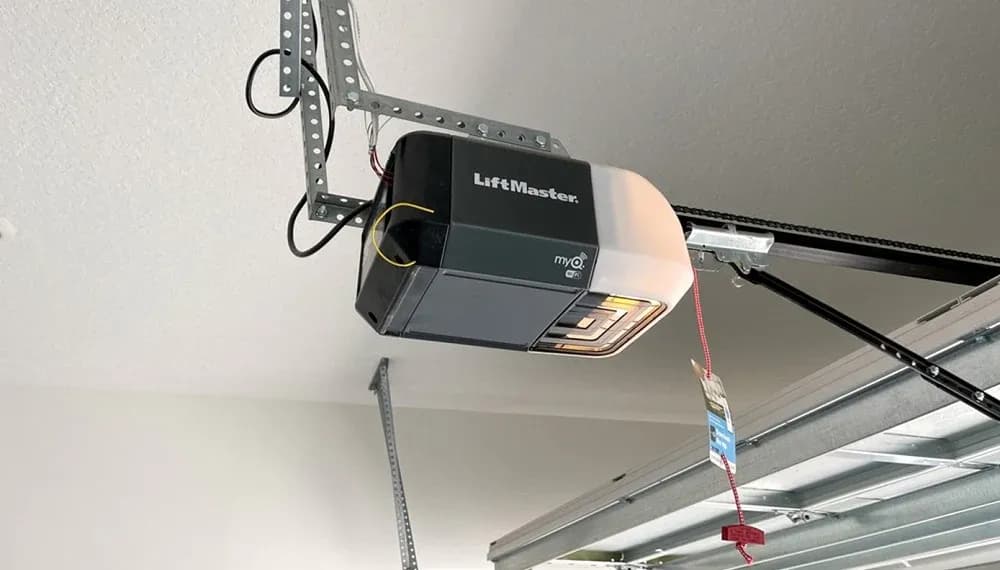
The biggest upgrades are battery backup, quieter DC motors, smartphone control and long-life LED lighting. We install LiftMaster and Linear openers, and here is what those manufacturers say their current lines offer:
- Battery backup: LiftMaster includes battery backup on openers such as its 8500W wall-mount and its WLED belt drive, so the door keeps working through a power outage. Nice says the Linear 621's built-in battery backup can keep it running for up to three days during a power failure.
- Quiet operation: LiftMaster pairs belt drive systems with DC motors for quiet operation and says the difference in sound and vibration between chain and belt drive is noticeable.
- Smart control: LiftMaster openers with built-in Wi-Fi work with the myQ app, so you can open, close and check the door from your phone.
- Wall-mount design: LiftMaster's wall-mount openers sit beside the door instead of hanging from the ceiling, which frees overhead space and, according to LiftMaster, reduces noise and vibration.
- LED lighting and updates: Nice says the Linear 621's integrated LED lighting means no bulbs to replace, and the opener can take firmware updates through the Nice G.O. app.
- Flexible drives: the Linear 621 comes in both chain and belt drive versions.
Which garage door opener drive type is right for your garage
Belt drive suits most attached garages, chain drive suits detached garages and shops, and a wall-mount unit makes sense when you want the ceiling clear and the door has torsion springs. Features vary by model, so we match the opener to the door, the garage and how you use it. You can see the lines we carry on our garage door openers page.
Wall-mount openers have the strictest requirements. Chamberlain's installation guide for its jackshaft models calls for a 1 inch torsion bar, at least 8.5 inches between the side wall and the end of the bar and a door that is properly balanced. Because they turn the torsion bar, they do not work on doors hung with extension springs, which is one reason we look at the door before recommending one.
| Drive type | How it moves the door | Noise | Good fit | Keep in mind |
|---|---|---|---|---|
| Chain drive | Steel chain pulls a trolley along a rail | Louder | Detached garages and shops | More vibration through the ceiling |
| Belt drive | Reinforced belt pulls the trolley | Quiet | Garages under bedrooms or living space | Often paired with a DC motor and battery backup |
| Wall-mount | Turns the torsion bar beside the door | Very quiet | High ceilings, storage racks and tall doors | Needs torsion springs and side clearance |
| Screw drive | Threaded steel rod moves the trolley | Louder than belt | Found in some existing garages | Check parts support before repairing |
What affects the cost of a new garage door opener
The cost of a new opener comes down to the drive type, the motor and features, the door it has to move and the condition of the garage around it. We quote it free after looking at the door, and these are the factors that move the number:
- Drive type and motor: belt and wall-mount units with DC motors sit above basic chain drives.
- Features: battery backup, built-in Wi-Fi, cameras, extra remotes and keypads all add to the total.
- Door size and weight: tall, wide or heavy insulated doors may need a stronger opener or a longer rail.
- Wall-mount setup: the door needs torsion springs, a suitable torsion bar and enough room at the side.
- Electrical: DASMA's checklist calls for a self-grounding or GFCI outlet within cord length of the opener and says extension cords are not permitted, so some garages need an electrician first.
- Door condition: a door that is out of balance or has worn springs should be fixed before any new opener goes on.
How does a Northern Michigan winter affect your opener
Cold rarely ruins a healthy opener, but it exposes a weak one. Grease stiffens, spring wire becomes more brittle, bottom seals freeze to the floor and the opener has to work harder through all of it.
Power outages matter too. When a winter storm takes the power out, an opener with battery backup keeps the door working, which is a real advantage for anyone who cannot lift a heavy insulated door by hand. That goes for a year-round home in Traverse City and for a lake cottage garage that sits closed for weeks between visits.
If your opener only struggles on the coldest mornings, start with the door. A balance check, fresh lubricant on rollers and hinges and an ice-free landing spot fix a lot of winter complaints before any opener work is needed. We serve Traverse City and the surrounding counties for both.
Sources
- 1.Non-Reversing Automatic Garage Door Openers Are a Hazard · U.S. Consumer Product Safety Commission
- 2.Residential Sectional Garage Door and Electric Operator Checklist (TDS 167) · DASMA
- 3.Garage Door Opener Diagnostic Codes and UP/DOWN Flashing Lights · Chamberlain Group
- 4.Jackshaft Opener: Installation requirements for the Residential Jackshaft Openers · Chamberlain Group
- 5.Quiet Garage Door Openers · LiftMaster
- 6.Nice Launches Linear 621 Garage Door Opener · Nice North America
Free estimate
Have our crew take a look
Three quick steps and our office calls you back during business hours. Most repairs are finished on the first visit, and every truck rolls out stocked.
Or call the office(231) 360-5442Mon to Fri · 7:30 am to 4:00 pm · Closed weekends
Request service
About a minute. Our office calls you back.
Step 1 of 3
- Your property
- What's going on
- Where we call you