Repair & Troubleshooting
How to test your garage door balance safely at home
· 10 min read · From the B&B Garage Doors office, Traverse City
To run a garage door balance test, close the door, pull the red manual release, then lift the door by hand until it is 3 to 4 feet off the floor and let go. A balanced door stays put or drifts slowly. If it drops or shoots up, the springs need a trained technician.
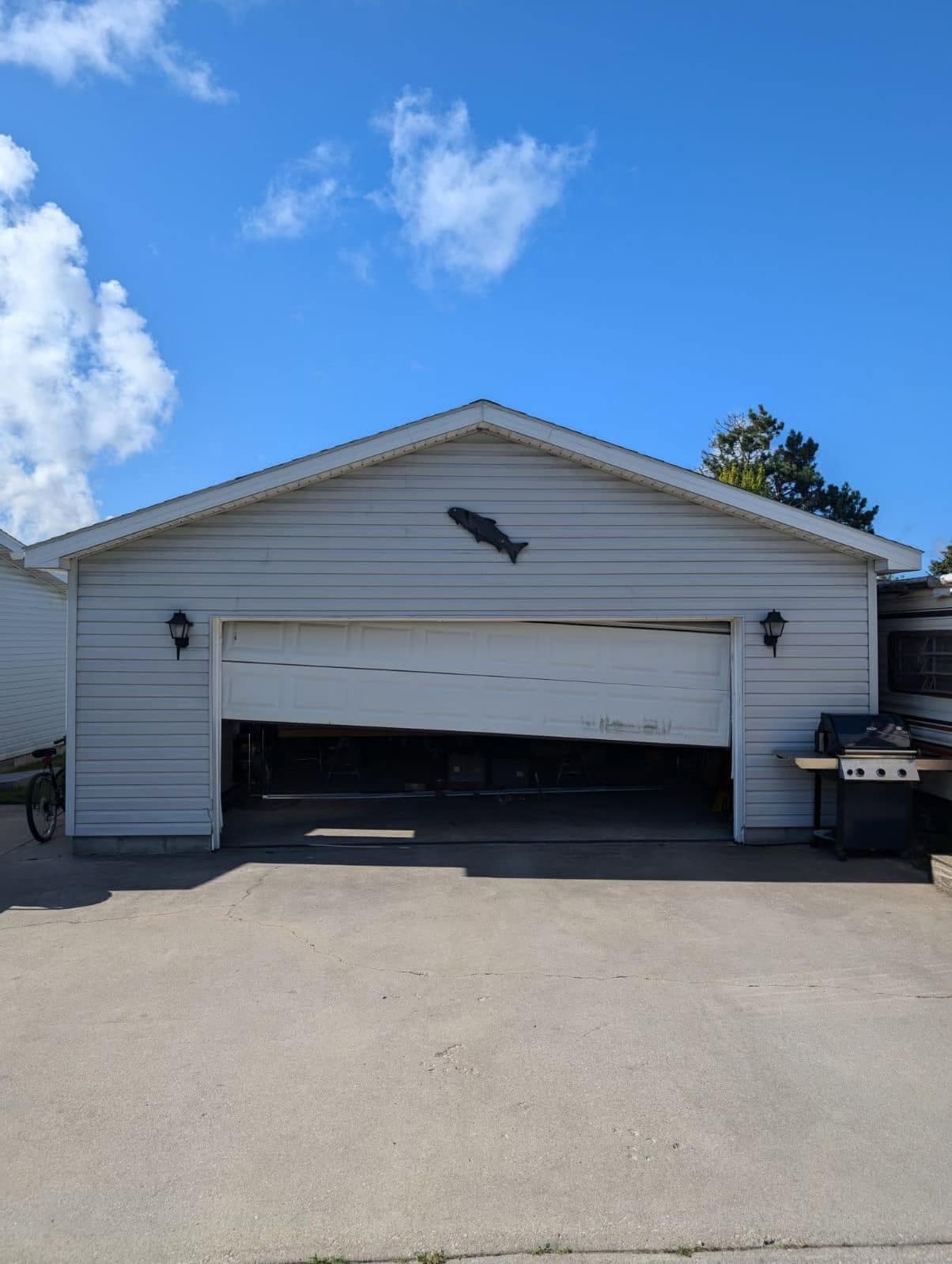
Door dropped when you let go?
Call the office · Mon to Fri · 7:30 am to 4:00 pm · Free estimates
What does a garage door balance test tell you
A garage door balance test tells you whether the springs, not the opener, are carrying the weight of your door. Genie puts it simply: when a door is balanced, the springs do the lifting and the weight is spread evenly across them.
Every sectional door has a counterbalance system. On most homes that means torsion springs on a shaft above the door or extension springs running beside the horizontal tracks, as DASMA describes in its home inspector checklist for sectional doors. The opener only guides a door that the springs have already made light.
The U.S. Consumer Product Safety Commission describes a properly working door as one that stays in place when stopped partway open. A severely unbalanced door can crash to the floor, which is why this simple check matters more than it looks.
How do you test garage door balance safely step by step
You test garage door balance by disconnecting the opener with the door fully closed, lifting the door by hand to about halfway and letting go. It is the same check DASMA's checklist asks home inspectors to perform, and it needs nothing but your hands and a clear floor.
Work slowly, stand to the side of the door rather than under it and keep kids and pets out of the garage while you test.
- 1Close the door all the wayStart with the door fully down and the car out of the way. Never begin this test with the door open.
- 2Look before you touch anythingFrom the floor, look at the springs and cables. If a spring has a visible gap, a cable is frayed or hanging loose, or the door sits crooked, stop here and leave the release alone. Our guide to a snapped or loose garage door cable explains why.
- 3Pull the red manual releasePull the red emergency release cord that hangs from the opener trolley. DASMA cautions that a door may unexpectedly begin to open when you disengage the opener, so keep one hand on the door.
- 4Lift the door by handGrip a handle or a flat spot where your fingers cannot get caught between sections. Chamberlain Group, the company behind LiftMaster, says a healthy door should move easily with one hand.
- 5Stop about halfway and let goRaise the door until the bottom is 3 to 4 feet off the floor, then ease your hands away. Stay beside the door, not under it.
- 6Watch what the door doesGive it a few seconds. Note whether it holds still, drifts slowly or moves with force, then compare what you saw to the table below.
- 7Lower it and reconnect the openerGuide the door gently back to the floor. Then reconnect the opener as described further down and run it through one full cycle.
What do the results of a garage door balance test mean
A door that stays put is balanced, a door that falls has springs that are too weak and a door that rises has springs wound too tight. A little slow movement is normal. Chamberlain treats a door that slams shut or shoots upward with force as out of balance, and Genie notes that the faster a door drops, the worse the imbalance.
Springs lose tension gradually, so a door that used to hold and now creeps down is telling you something. Catching it early is far easier than dealing with a spring that lets go on a January morning.
| What the door does | What it usually means | Keep using it? | What we suggest |
|---|---|---|---|
| Stays put or barely moves | Springs are balanced | Yes | Test again next month |
| Drifts down slowly | Springs are starting to weaken | Yes, with care | Have springs checked at a garage door tune-up |
| Drops fast or slams shut | Springs are weak or one is broken | No, keep it closed | Call for spring repair |
| Rises or shoots up | Too much spring tension | No, keep it closed | Have a technician reset the tension |
| Heavy or lifts crooked | Weak spring or cable problem | No | Leave the opener off until it is checked |
| Binds, jerks or rubs | Track, roller or hinge trouble | Use caution | See our off-track door guide |
Why does an unbalanced garage door wear out your opener
An unbalanced door makes the opener lift weight the springs are supposed to carry, and openers are not built for that. Genie says the strain makes an opener work harder than it should and can cause many parts to break or fail.
You often notice it before you diagnose it. The opener slows down, groans at the start of each cycle, stops short or reverses for no clear reason. Chamberlain notes that a door must be properly balanced for the opener's limit and force settings to be set correctly, so a door that is out of balance throws those settings off too.
Turning up the force setting to push a heavy door through hides the real problem and works against the safety reverse. Fix the balance first. If the opener has already taken a beating, our guide on whether to repair or replace your garage door opener walks through the next decision, and our crew handles garage door opener repair as well.
Why should you never adjust garage door springs yourself
Garage door springs store enough energy to cause serious injury, and adjusting them safely takes winding bars, matched parts and training. DASMA is blunt about it: homeowners should not remove, repair or adjust springs, cables or brackets, and all repairs and adjustments belong to a trained door systems technician using proper tools and instructions.
Torsion springs are wound on a shaft above the door, and every turn adds force. Extension springs stretch along the tracks and should always have a containment cable running through the middle. A slipped winding bar or a set screw loosened at the wrong moment can release that force all at once, and no video makes that safe. When the balance test fails, garage door spring repair is the fix, not an adjustment kit.
What you can safely do is keep the door easy on its springs:
- Lubricate rollers, hinges and bearings. Leave the tracks clean and dry.
- Keep the tracks clear of debris, ice and anything stored against them.
- Wipe the photo eye lenses and make sure the two sensors face each other.
- Check the bottom seal and weatherstripping for tears that let ice build up.
- Book a yearly tune-up so a technician checks spring condition and cable wear.
How do you reconnect the garage door opener after the test
Put the door fully down, reset the release and run the opener once so the trolley latches back onto the door. The exact motion depends on your opener's rail, according to Chamberlain's support guide:
- Square rail openers: pull the release cord toward the opener so the release arm returns to level, then run the opener. The trolley reconnects during the cycle.
- T-rail openers: pull the cord straight down, then run the opener. The door reconnects on the next up or down cycle.
- Wall-mount openers: pull the release handle straight down firmly until it clicks, then run the opener.
How do you test the garage door auto reverse each month
Lay a 2x4 flat on the floor under the center of the open door, close the door with the wall button and make sure it reverses as soon as it touches the board. DASMA's checklist uses exactly that setup: a solid object about an inch and a half high, which is what a 2x4 laid flat gives you.
Test the photo eyes the same way. While the door is closing, wave an object through the beam near the floor, staying well clear of the door itself. The door should stop and go back up. DASMA's checklist also looks for a sensor beam no higher than six inches above the floor.
If the door does not reverse, the CPSC advises disconnecting the opener until it is adjusted, repaired or replaced. Use the door by hand in the meantime, and only if it passed the balance test. If the trolley would not catch earlier or the opener hums without moving the door, our guide to why a garage door won't open covers the next checks.
How often should you test your garage door balance
Test balance once a month, which is the schedule Genie recommends, and run the auto reverse test at the same time. The CPSC likewise tells homeowners to inspect the door and opener every 30 days.
Also test right away after anything unusual: a loud bang from the garage, a door that suddenly feels heavy, an opener that strains or a door that closes crooked. Tying the check to the first of the month makes it easy to remember.
Once a year, a professional visit goes deeper than any home check. A technician looks at spring condition, cables, bottom brackets, rollers and hinges, then sets the opener's limits and force once the door is balanced.
Does Northern Michigan cold weaken garage door springs
Yes. Clopay, the garage door manufacturer, notes that spring wire becomes more brittle in cold temperatures, which is why broken springs happen more often in winter.
Cold also stiffens grease, so a door that was borderline in September can feel heavier in January even before a spring fails. Clopay warns against using WD-40 on a garage door because it can cause problems in cold weather, and recommends a silicone-based lubricant instead.
That makes fall the best time for a balance test up here. A door that drifts in October will not get better through the winter. Our crew works out of an office south of Traverse City off US-31 and handles garage door repair in Traverse City and the surrounding counties.
Sources
- 1.Residential Sectional Garage Door and Electric Operator Checklist (TDS 167) · DASMA
- 2.How to test the balance of a garage door · Chamberlain Group
- 3.How to Manually Open or Close a Garage Door · Chamberlain Group
- 4.How to Check If Your Garage Door Is Balanced · The Genie Company
- 5.Fixing Garage Door Problems from Cold Weather · Clopay
- 6.Non-Reversing Automatic Garage Door Openers Are a Hazard · U.S. Consumer Product Safety Commission
Free estimate
Have our crew take a look
Three quick steps and our office calls you back during business hours. Most repairs are finished on the first visit, and every truck rolls out stocked.
Or call the office(231) 360-5442Mon to Fri · 7:30 am to 4:00 pm · Closed weekends
Request service
About a minute. Our office calls you back.
Step 1 of 3
- Your property
- What's going on
- Where we call you