Repair & Troubleshooting
How to tell torsion springs from extension springs on your garage door
· 11 min read · From the B&B Garage Doors office, Traverse City
Torsion springs sit on a metal shaft above the garage door and twist to lift it. Extension springs run beside the horizontal tracks on each side and stretch. Clopay says torsion springs suit heavier or high-use doors and last longer, and extension springs suit lighter doors and low headroom. Both hold dangerous tension, so leave repairs to a technician.
Not sure which springs you have?
Call the office · Mon to Fri · 7:30 am to 4:00 pm · Free estimates
How do you tell which garage door springs you have
Close the door, stand inside the garage and look up. One or two tightly wound coils on a metal shaft across the wall above the door are torsion springs. Long springs that run beside the horizontal tracks on each side are extension springs.
DASMA, the door manufacturers' association, describes the two layouts the same way in its checklist for home inspectors and consumers: torsion springs mounted above the door header, or extension springs found next to the horizontal tracks. You can sort out which you have in a minute without touching anything.
- 1Close the door all the waySprings are easiest to read with the door down. DASMA's checklist has inspectors look at the springs from inside the garage with the door fully closed.
- 2Look at the wall above the doorA metal shaft running the width of the door with one or two coils wrapped around it means torsion springs. The lift cables wind onto a drum at each end of that shaft.
- 3Look along the tracks near the ceilingIf the wall above the door is bare, follow the horizontal tracks back into the garage. A long spring running parallel to each track means extension springs.
- 4Look for a cable through each extension springA steel cable threaded through the middle of the spring from end to end is the safety cable. Note whether both springs have one.
- 5Note the count and the conditionCount the springs and look for a gap in a coil, rust or a spring that looks stretched out. Do it by eye from the floor and keep your hands off the hardware.
How does a torsion spring lift a garage door
A torsion spring lifts the door by unwinding. Clopay's guide to garage door spring systems describes torsion springs as mounted horizontally above the door on a metal shaft, storing energy as torque and unwinding to raise the door.
When the door is closed the spring is wound tight. As the door opens, the spring turns the shaft, the drums at each end of the shaft wind up the lift cables and the cables pull the door up from its bottom corners. Closing the door winds the spring back up for the next trip.
Because one shaft serves both sides of the door, the lift is shared across its width. Clopay says torsion springs give smoother, more controlled motion and better balance across the door, which reduces wear on the opener. It recommends them for heavier or high-use doors.
A broken torsion spring is easy to spot. Clopay says the spring splits into two separate pieces, so you see a gap where there used to be one continuous coil.
How does an extension spring lift a garage door
An extension spring lifts the door by pulling back to its resting length. Clopay describes extension springs as running parallel to the tracks on either side of the door, stretching as the door comes down and contracting as it goes up.
Each side of the door has its own spring, connected to the bottom corner of the door through a cable and pulleys. With the door closed the springs are stretched and holding the most tension. DASMA points out that extension springs are under high tension when the door is down.
Clopay says extension springs are typically less expensive and often simpler to install, and that they suit lighter single-car doors and garages with limited headroom.
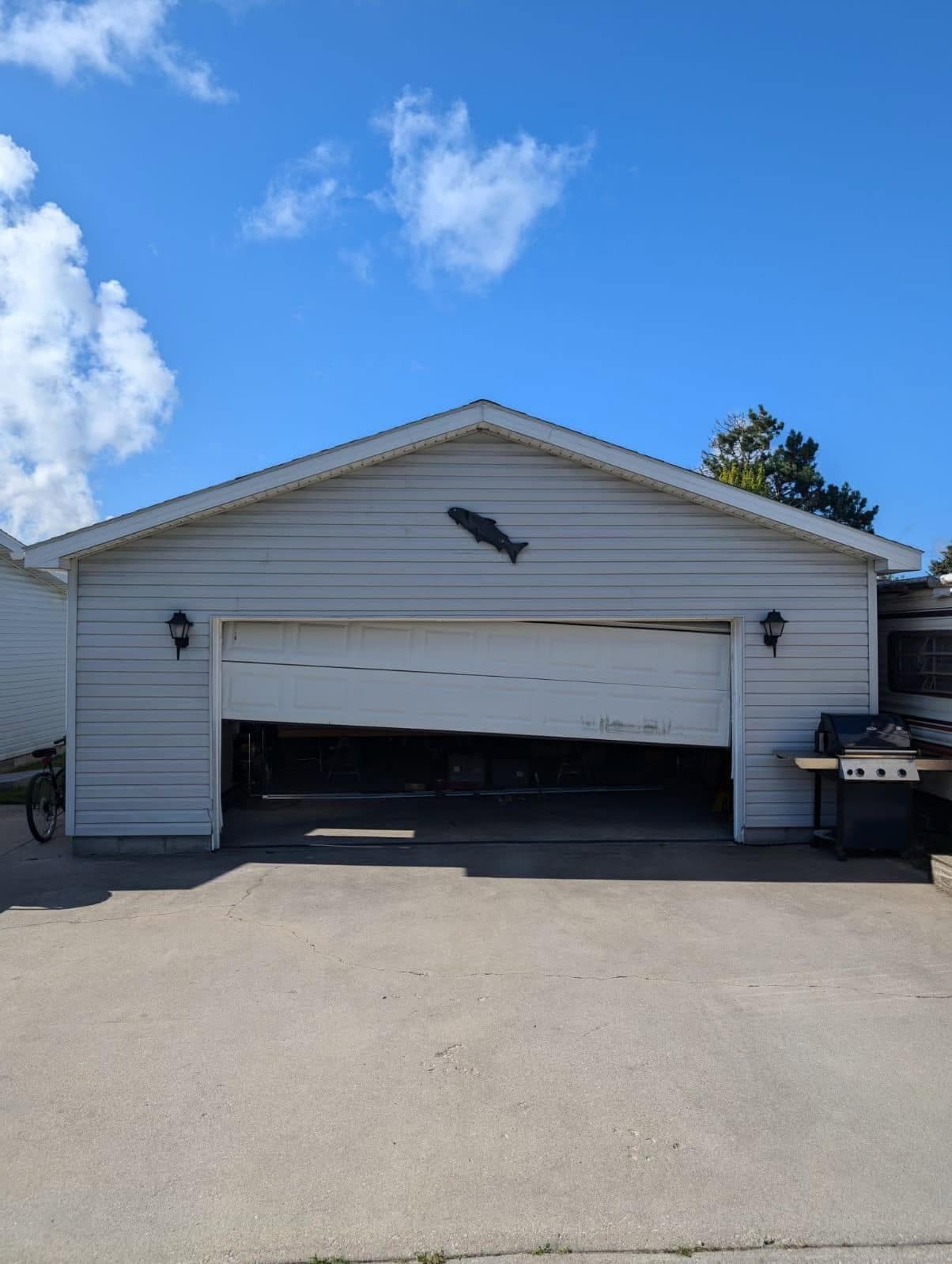
Since each side is lifted by its own spring, the two sides can fall out of step when one spring weakens. Clopay lists a door that moves crooked among the signs of spring trouble, along with an extension spring that looks stretched out or damaged.
What is the difference between torsion and extension springs
The difference is where the spring sits and how it stores energy. A torsion spring twists on a shaft above the door, and an extension spring stretches beside the track. Both do the same job of counterbalancing the weight of the door, and both wear out.
One practical difference shows up when you shop for an opener. Chamberlain's installation requirements for its wall-mount openers call for a 1 inch torsion bar and a properly balanced door, because that style of opener turns the bar above the door. A door hung on extension springs has no torsion bar to turn, so raise it before you choose a new garage door opener.
The chart puts the two side by side, using Clopay's and DASMA's descriptions.
| Torsion springs | Extension springs | |
|---|---|---|
| Where they sit | On a metal shaft above the door | Beside the horizontal track on each side |
| How they store energy | By twisting | By stretching |
| How to spot them | One or two coils on the wall above the door | A long spring running along each ceiling track |
| Doors Clopay says they suit | Heavier or high-use doors | Lighter single-car doors and garages with limited headroom |
| How the door is lifted | One shaft lifts both sides together | Each side is lifted by its own spring |
| What contains a broken spring | The shaft through the spring | A safety cable through the spring |
| Spring life according to Clopay | Built to last significantly longer | Shorter than a torsion spring |
| How a break looks | A gap in the coil | A spring that hangs loose or looks stretched out |
| Wall-mount opener | Turns the torsion bar | No torsion bar for it to turn |
Do extension springs need safety cables
Yes. DASMA's checklist says extension springs should be contained by a secure cable running through the center of the springs, and that containment helps prevent broken parts from flying dangerously in the garage when a spring breaks.
Torsion springs do not need one. DASMA notes that they are mounted on a shaft, which inherently provides containment. An extension spring has nothing inside it unless someone installed a cable. Clopay explains that extension springs can snap back with significant force, and that the safety cable runs through the center of the spring and anchors to the wall or ceiling.
Checking takes a flashlight. With the door closed, look for a steel cable running through the middle of each spring from one end to the other. If you cannot find one, DASMA's garage door safety tips say to call your local dealer for a safety inspection. Adding safety cables is something our garage door spring repair crew can do.
Which garage door spring lasts longer
Torsion springs generally last longer. Clopay says torsion springs are built to last significantly longer than extension springs, though both wear out by use and not by the calendar.
Spring life is counted in cycles. Clopay's guide to broken springs says most garage door springs are designed to last 10,000 cycles, with one cycle being a trip up and down. Its spring guide puts the average garage door at about 1,500 open and close cycles a year. At that pace a 10,000 cycle spring is used up in under seven years, and a door that runs twice as often gets there in half the time.
The design figure is not a promise. DASMA's data sheet on spring cycle life covers both torsion and extension springs and lists what cuts their life short: a spring matched to the wrong door, a door made heavier than the manufacturer's specifications, rust and missed maintenance. It says rust reduces the strength of spring wire and that regular lubrication helps maximize cycle life.
Our guide to how long garage doors and their parts last sets spring life next to the rest of the door.
Can you convert extension springs to torsion springs
Often yes, but it depends on the door and the space above it, so it takes a technician looking at your garage to answer.
A torsion system needs a shaft, springs and hardware mounted on the wall above the door, which means room between the top of the opening and the ceiling. Clopay notes that extension springs suit garages with limited headroom, and a garage that was built tight may not have the space a torsion setup wants.
A conversion is also more than trading one spring for another. Clopay says a torsion spring has to be chosen for the door's weight, height and track configuration, which makes it technician work from start to finish.
People usually ask when an extension spring has broken, when the door has always run rough or when they want a wall-mount opener. If that is you, say so when you call. We will look at the door and the headroom and tell you plainly whether a conversion makes sense or whether new extension springs with safety cables are the better answer.
Why are both garage door springs replaced together
Because they have done the same work. Springs installed together have been through the same number of cycles, so when one breaks the other is close behind.
DASMA's advice is direct: if your door has two springs, replace both, even if one is not broken. Clopay gives the same advice and a reason, saying both should be replaced at the same time for smooth operation and door longevity.
If a spring has already let go on your door, our guide on what to do when a garage door spring breaks covers the first steps and what to leave alone.
What do Northern Michigan garages and winters mean for your springs
Up here the garage often hints at which springs to expect, and the winter tends to decide when they give out. Clopay says springs break most often during cold weather, which makes the metal more brittle.
Elk Rapids has a stock of older village homes on compact lots, and their garages are often detached and on the small side. A lighter door in a low garage is the setting Clopay describes for extension springs, so those are the garages where a safety cable check is worth a minute. Up the Chain of Lakes toward Torch Lake, cottage garages sit closed for months, and a spring can break with nobody there to hear it.
East of Acme along M-72, Williamsburg mixes cottages on Elk Lake and Lake Skegemog with rural parcels in Whitewater Township, many with a pole barn or detached shop. Wide and tall doors are heavy, which puts them in the territory Clopay assigns to torsion springs. The old door on an outbuilding also tends to keep its rusted hardware longer than it should, and DASMA says rust weakens spring wire.
Kalkaska sits where US-131 and M-72 cross, far from the milder air along Lake Michigan and the bay, and winter there is long, cold and snowy. We cover Kalkaska, Elk Rapids and the rest of Antrim County from our office south of Traverse City.
When should you call about your garage door springs
Call when a spring is broken, when the door has changed how it moves or when you cannot find a safety cable on an extension spring. Clopay suggests a visual check of the springs every couple of months, and these are the things to watch for.
A spring check is part of every garage door tune-up, and our crew replaces both torsion and extension springs. Every truck rolls out stocked, and most repairs are finished on the first visit.
- A gap in a torsion spring's coil, or an extension spring that hangs loose or looks stretched out.
- A loud bang from the garage followed by a door that feels very heavy.
- A door that rises crooked, jerks or stops partway.
- An opener that strains harder than it used to.
- A door that drifts down when you stop it halfway. Our garage door balance test shows the safe way to check.
- Extension springs with no cable running through them.
- Rust on the coils, or springs nobody has looked at in years.
Sources
- 1.Garage Door Spring Systems: A Buying Guide for Homeowners · Clopay
- 2.Do I Have a Broken Garage Door Spring? · Clopay
- 3.TDS 167: Residential Sectional Garage Door and Electric Operator Checklist for Home Inspectors and Consumers · DASMA (Door & Access Systems Manufacturers Association)
- 4.TDS 190: Factors Affecting Spring Cycle Life · DASMA (Door & Access Systems Manufacturers Association)
- 5.Garage Door Safety Tips · DASMA (Door & Access Systems Manufacturers Association)
- 6.Jackshaft Opener: Installation requirements for the Jackshaft Openers · Chamberlain Group
Free estimate
Have our crew take a look
One short form and our office calls you back during business hours. Most repairs are finished on the first visit, and every truck rolls out stocked.
Or call the office(231) 360-5442Mon to Fri · 7:30 am to 4:00 pm · Closed weekends
Request service
About a minute. Our office calls you back.