New Doors & Openers
How to decide whether to repair or replace your garage door
· 11 min read · From the B&B Garage Doors office, Traverse City
Most garage door problems are repairs. A broken spring, a frayed cable, worn rollers, a failed opener or one dented section can usually be fixed on a door that is otherwise sound. Replacement makes sense when several sections are damaged, the door is rusted or rotted through, matching sections are no longer made or the door is unsafe.
Wondering if your door is worth fixing?
Call the office · Mon to Fri · 7:30 am to 4:00 pm · Free estimates
Should you repair or replace your garage door
Repair it when a part has failed and the door itself is sound, and replace it when the door itself is what is failing. The parts that move a garage door wear out and get replaced as a matter of routine. The sections, which are the door, are what decide whether it is worth keeping.
You can sort out a lot before anyone comes to the house, and none of it involves touching a spring, a cable or a bracket. Work through these steps, then call with what you found.
- 1Name what actually failedA loud bang and a door that won't lift, a cable hanging loose, an opener that hums and a dent from a bumper are all different problems. Write down what the door did.
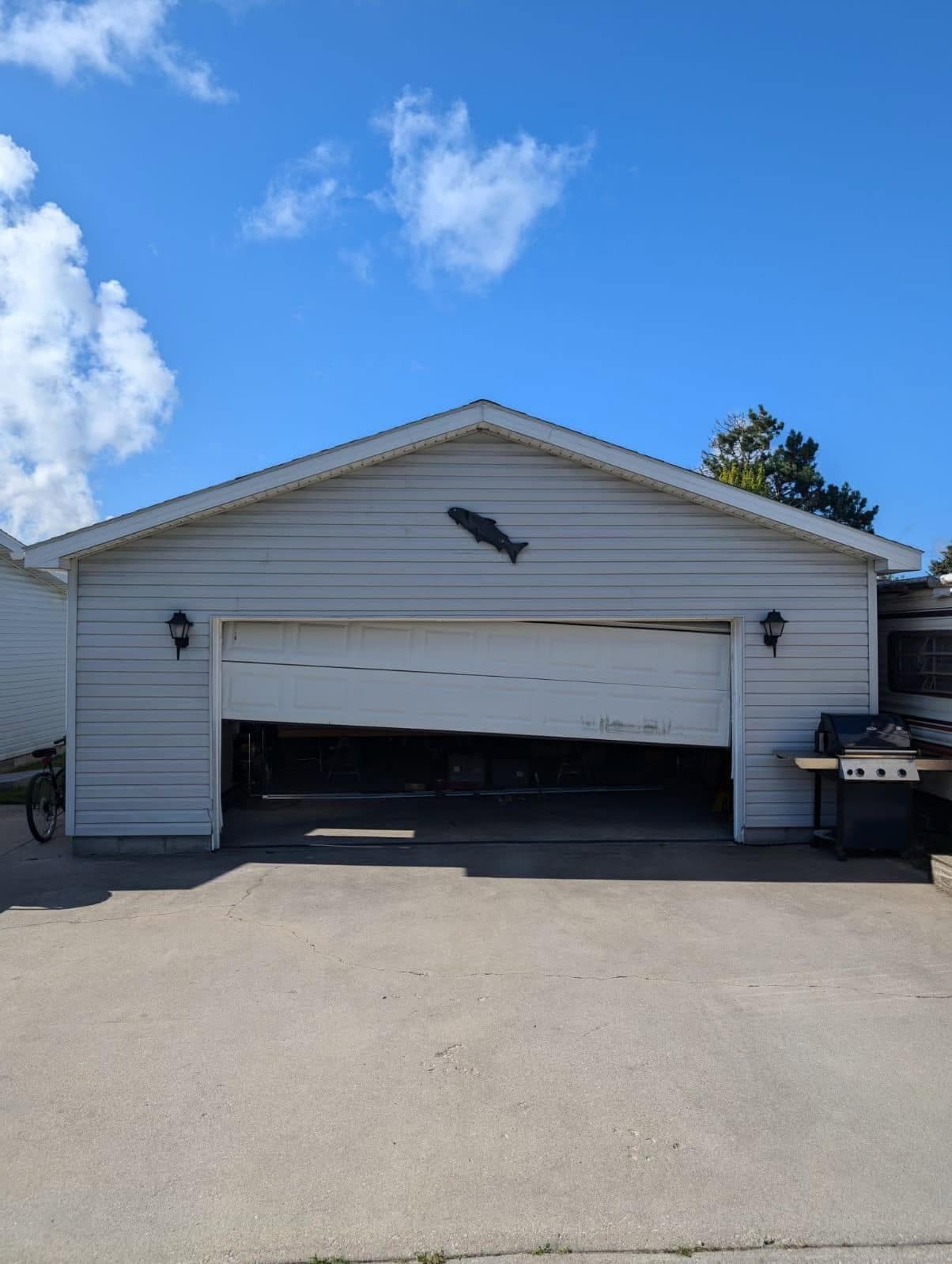
- 2Look at every section from outsideWith the door closed, look for dents, cracks, rust that has eaten through the steel and sections that bow or sag. Count how many sections are affected.
- 3Look at the same sections from insideCheck the bottom section closely, since that is where water, salt and slush sit. On a wood door, look for soft, split or swollen wood along the bottom edge.
- 4Find the maker's labelMany doors carry a label or serial number on the inside. Clopay says the serial number is the easiest way to identify the model when a replacement section has to be matched. Take a photo of it.
- 5Photograph the door and the hardwareTake a wide shot inside and out, then close-ups of the damage, the springs and the bottom corners. Never stand under an open door.
- 6Ask for both answers in writingWhen the door could go either way, ask for a written estimate for the repair and a written quote for a new door.
Which garage door problems are almost always a repair
A broken spring, a snapped or frayed cable, worn rollers, loose hinges, a bent track and a failed opener are almost always repairs. These are the parts that do the work every time the door moves, so they wear out long before a well-built door does.
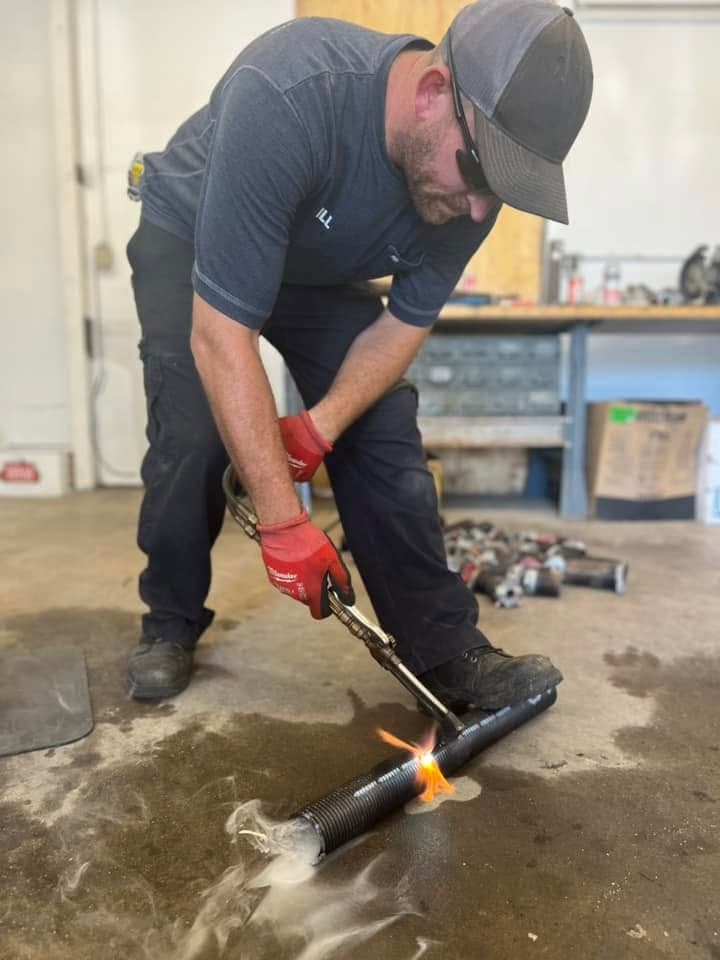
- Springs: a broken spring is a common reason a door suddenly won't lift. DASMA, the door industry's trade association, says springs wear out and that when a door has two springs both should be replaced even if only one is broken. That is garage door spring repair, and the door stays.
- Cables: Clopay's service guide warns that frayed cables are in danger of breaking and tells owners to have a professional replace them.
- Rollers and hinges: noisy, cracked or seized rollers and loose hinges are small parts that are replaced on the spot.
- Tracks: a bent or loose track can usually be straightened or replaced without touching the sections. That is everyday garage door repair.
- The opener: a dead, noisy or unreliable opener is a separate machine from the door. It can be repaired or replaced on its own.
Can you replace one garage door panel instead of the whole door
Often yes. A garage door is built from horizontal sections, and when the damage is confined to one or two of them, replacing just those sections is likely a feasible option, according to Clopay's guide to replacing garage door panels.
The catch is matching. Clopay says ordering a replacement section takes the model of the door, the size of the section, the color and which section is needed: top, bottom or middle. Paint and finish also age, so a new section may not look identical to the ones beside it.
Clopay names the points where a single section stops making sense. If the door is over 15 years old and replacement panels are no longer available, if there are sagging or bent panels or major damage across multiple panels, or if the damage extends to the door's frame, it says a full replacement may be the more cost-effective choice. If the damage came from a bumper, our guide for when you have backed into your garage door walks through what to do first.
What tips the decision toward a new garage door
The decision tips toward a new door when the sections themselves are failing, when they cannot be matched or when the door is not safe to keep running.
- Several damaged sections: a hard hit that bent more than one or two sections, or sections that sag across their width, leaves little of the original door worth saving.
- Rust through the steel: surface rust can be cleaned and touched up. Rust that has eaten through the bottom section, where salt and slush sit all winter, is a different matter, because the section itself is failing.
- Rot in a wood door: wood takes on moisture and moves through our long freeze and thaw seasons. Soft, split or swollen wood at the bottom edge and the joints means the section is no longer sound.
- Discontinued sections: if the manufacturer no longer makes a section that fits your door, a damaged one cannot be matched, and the whole door has to be replaced.
- Safety: the CPSC says doors that are out of balance, bind or stick should be serviced by a professional. If the cause is in the sections themselves, replacement is the fix.
What does a repair or replace decision chart look like
Match what you see on your door to the chart below. The last column is the question that usually decides a close call.
| What you have | Usual answer | Why | What decides a close call |
|---|---|---|---|
| Broken spring | Repair | Springs are wear parts | Nothing unless the door is also failing |
| Frayed or snapped cable | Repair | Cables are replaced on a sound door | The condition of the brackets and sections |
| Opener dead or unreliable | Repair or replace the opener | The opener is separate from the door | Age and safety features of the opener |
| One dented or cracked section | Replace the section | The rest of the door is sound | Whether a matching section is still made |
| Several bent or sagging sections | Replace the door | Little of the door is left to save | How many sections are affected |
| Rust or rot through the bottom section | Replace the door | The section itself is failing | Whether the damage is surface only |
| Sections no longer made | Replace the door | Damage cannot be matched | The maker's label and model |
| Cold uninsulated door on an attached garage | Your choice | The door works but the garage is cold | How you use the garage |
Is an uninsulated door on an attached garage worth replacing
It can be, if you heat the garage, have a room above it or are tired of a cold wall against the house. A working door with no insulation is not broken, so this is a comfort decision and not a repair decision.
If you do upgrade, compare doors carefully. DASMA Technical Data Sheet 163 explains that an R-value is calculated for a door section only, while a U-factor is tested on the entire installed door, and that the two are not comparable. DASMA says the tested U-factor gives the highest degree of confidence when comparing doors, and that a lower U-factor means better insulation.
Be cautious about adding material to an existing door. The springs are matched to the weight of the door, so anything that changes that weight changes how the door balances. Our guide to insulated garage doors and R-value goes deeper.
Is an old garage door opener a reason to replace the door
No. An old or unsafe opener is a reason to replace the opener. The door and the opener are separate.
Age does matter for the opener itself. The U.S. Consumer Product Safety Commission says openers made or imported for sale in the United States after January 1, 1991 must have a reversing system, and that a requirement for an external entrapment protection system, such as an electric eye, was added in 1993. The CPSC urges homeowners to replace older openers that do not automatically reverse.
The CPSC's test is simple: place a 2x4 on the floor in the door's path and close the door. If the door does not properly reverse when it strikes the board, the opener should be disengaged until it is adjusted, repaired or replaced. Our guide on whether to repair or replace a garage door opener covers that decision, and we install LiftMaster and Linear openers.
What questions should you ask before you decide
Ask questions that make the technician show the reasoning, not just the price. Clear answers tell you whether you are looking at a repair, a section or a door.
- What exactly failed, and can you show me the part?
- Is the rest of the door sound: the sections, the hinges, the track and the bottom brackets?
- Is a matching section still made for this door, and will the color match?
- If I repair it today, what else on this door is close to worn out?
- Does the opener reverse on a 2x4 and have working photo eyes?
- Can I have the repair and the replacement in writing so I can compare them?
- If I replace it, are the track, springs and hardware new and matched to the new door?
Why would a good company tell you a repair is enough
Because an honest company recommends repair whenever repair is the sound choice, and explains why when it is not. Springs, cables, rollers, hinges and most opener problems are routine repairs on a door that is otherwise solid, and a company that plans to be around next year does better by telling you so.
Be wary of the opposite. A technician who pushes a whole new door for a broken spring, will not show you the failed part or wants a decision on the spot is not doing a diagnosis. Our guide on how to choose a garage door company lists the red flags and the questions that expose them.
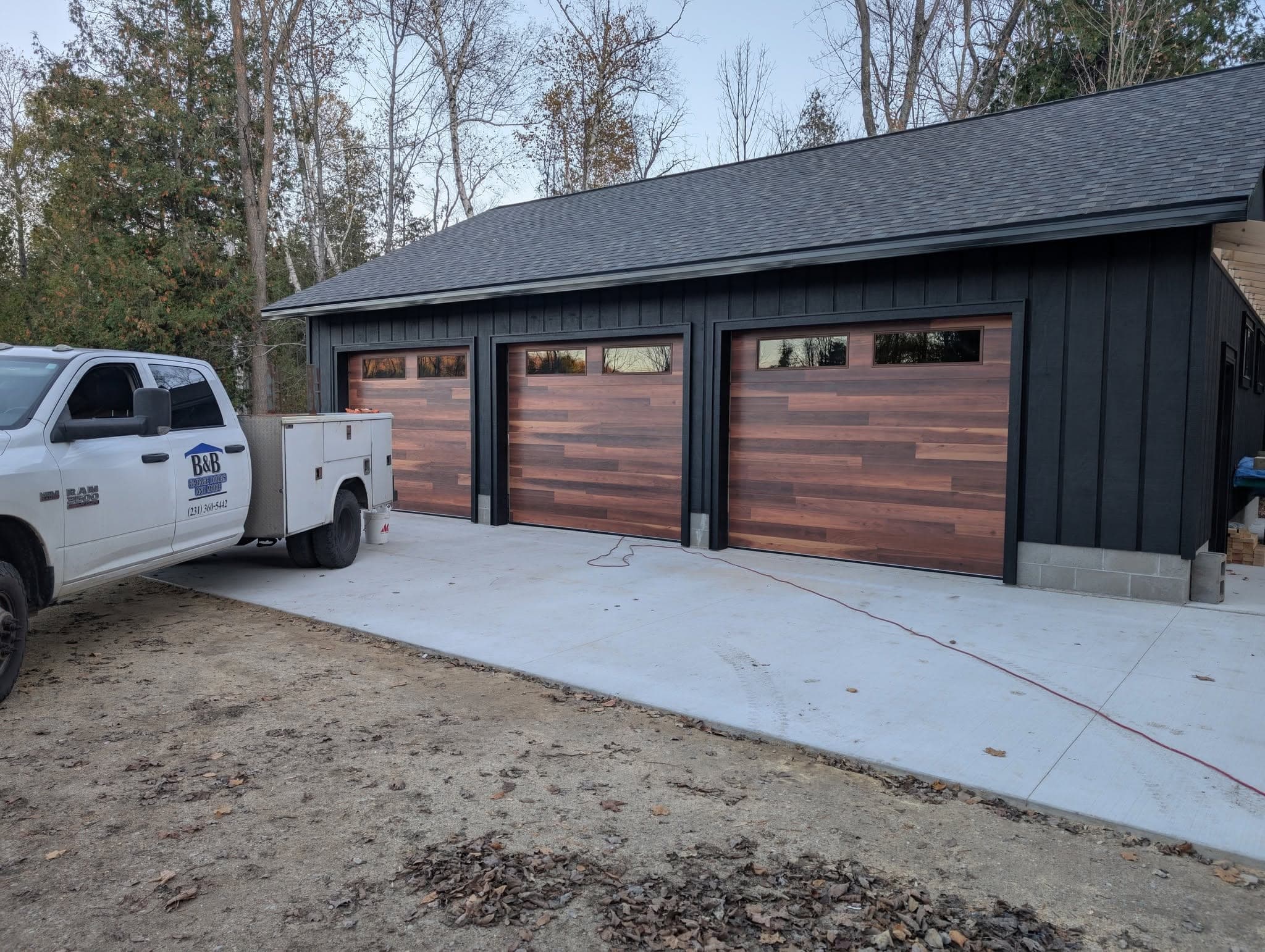
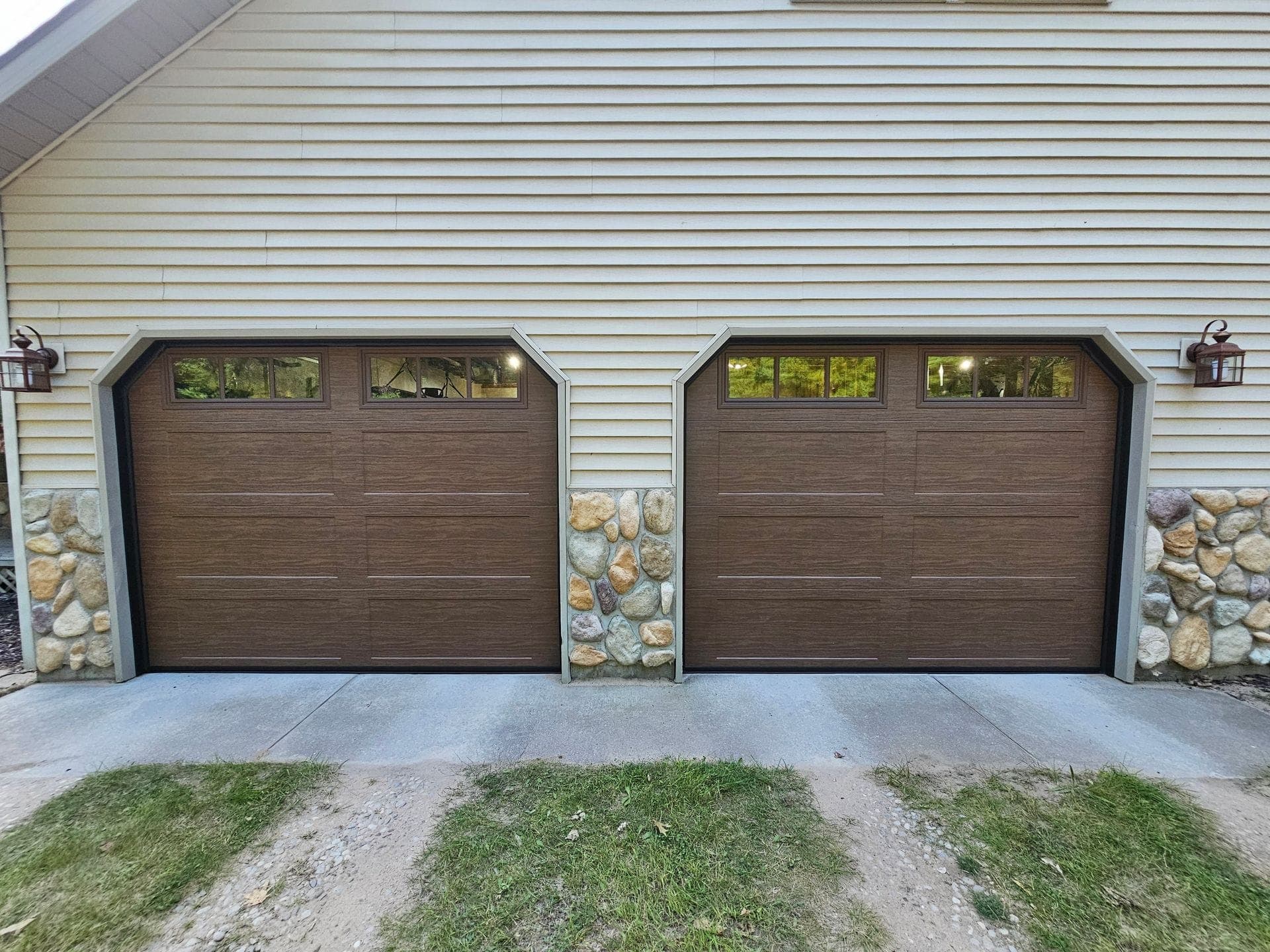
B&B Garage Doors and More is father and son owned by Tony and Jake Bailey. Every truck rolls out stocked, most repairs are finished on the first visit and estimates are free. When a door really is past repair, we install new garage doors from Haas Door, Safe-Way Door, Richards-Wilcox and Eden Coast.
How does repair or replace play out around Traverse City
Around Grand Traverse Bay it depends on where the garage sits and how the door is used.
In Traverse City, the older streets of Slabtown, Old Town and the Central Neighborhood have narrow detached garages, many with doors that have been patched more than once. Those are the doors where it is worth asking whether sections can still be matched. Out in Garfield Township and East Bay Township, attached garages go up and down several times a day, so springs, rollers and openers wear first. That is repair work on doors that are usually sound.
In Acme, homes and condos along the shore face open water and take wind straight off East Grand Traverse Bay. Worn weatherstrip shows up fast there as drafts and snow on the garage floor, and new seals are a repair.
On Old Mission Peninsula, homes along Peninsula Drive get damp air and wind off the bay, and farm properties along Center Road have pole barns with oversize doors that see hard use. Many peninsula homes are second homes, and a door that sat closed for months can come back with a broken spring or a stiff opener. Neither of those means a new door. We cover all of Grand Traverse County from our office south of town.
Sources
- 1.Can I Replace My Garage Door Panels? · Clopay
- 2.Garage Door Replacement Parts Guide · Clopay
- 3.Garage Door Safety Tips · Door & Access Systems Manufacturers Association (DASMA)
- 4.Technical Data Sheet #163: U-factor and R-value for Residential and Commercial Garage Doors · DASMA
- 5.Non-Reversing Automatic Garage Door Openers Are a Hazard (Publication 523) · U.S. Consumer Product Safety Commission
Free estimate
Have our crew take a look
One short form and our office calls you back during business hours. Most repairs are finished on the first visit, and every truck rolls out stocked.
Or call the office(231) 360-5442Mon to Fri · 7:30 am to 4:00 pm · Closed weekends
Request service
About a minute. Our office calls you back.