New Doors & Openers
What an insulated garage door R-value really tells you
· 11 min read · From the B&B Garage Doors office, Traverse City
An insulated garage door R-value tells you how well one door section resists heat flow, and a higher number is better. It is usually calculated, not tested, and it leaves out the joints, seals and hardware. A tested U-factor covers the whole installed door. In Northern Michigan, tight seals and careful installation matter as much as the number.
Garage colder than it should be?
Call the office · Mon to Fri · 7:30 am to 4:00 pm · Free estimates
What does R-value mean on an insulated garage door
R-value is a measure of how well a material resists heat moving through it, and the greater the number, the better the insulation. The U.S. Department of Energy puts it simply in its Consumer Guide to Home Insulation: the ability of insulation to reduce heat flow is called its R-value, and the greater the R-value, the more that heat flow is reduced.
On a garage door the number comes almost entirely from the foam. DASMA, the trade association for door makers, explains that a door section's R-value is added up from the insulation, the inside and outside surfaces and a thin film of air on each face. It treats the R-value of steel and other metal facings as negligible, so a plain steel door with no foam has almost nothing to slow the cold.
That is why an uninsulated door feels like a sheet of cold metal in January, and why the brochure number is worth understanding before you compare doors.
What is the difference between R-value and U-factor
R-value is usually a calculation for a single door section, while U-factor is a lab test of the whole installed door. With R-value higher is better. With U-factor lower is better. DASMA Technical Data Sheet 163 says the two methods are not comparable and that, for garage doors, they are not reciprocals of each other.
The calculated method takes the thickness of the foam and divides it by the foam's thermal conductivity, then adds a fixed allowance of 0.85 for the air films. In DASMA's own worked example, a 22 inch tall polyurethane section comes out to R-16.47. The sheet is clear that this method does not account for section joints and stile attachments, and says it should not be used for a complete door assembly.
The tested method follows a standard called ANSI/DASMA 105. A complete door with its sections, track, hardware and seals goes into a chamber, the inside face is kept at a constant temperature, the outside face is cooled and the lab measures the energy it takes to hold the inside steady. DASMA says a tested U-factor gives the highest degree of confidence when comparing doors, and that building codes deal with garage door thermal performance in terms of U-factor.
| Question | R-value | U-factor |
|---|---|---|
| What it describes | One door section | The complete installed door |
| How it is found | Calculated from foam thickness | Tested in a lab chamber under ANSI/DASMA 105 |
| Better number | Higher | Lower |
| Counts joints, seals and hardware | No | Yes |
| Best use | Comparing foam between similar doors | Comparing finished doors |
Is polyurethane or polystyrene better in a garage door
Polyurethane insulates better for the same thickness and makes a stiffer door, while polystyrene is a sound choice where the garage does not need to hold much heat. The difference is in how the foam gets into the section.
The Department of Energy's guide describes polystyrene as a rigid board and polyurethane as a foamed-in-place insulation that can fill even the smallest cavities. Haas Door, one of the door lines we install, says its polyurethane expands to fill the panel and becomes fully adhered to the steel skins, forming a composite section of exceptional strength and rigidity. It describes polystyrene as a rigid foam board that must be attached to or inserted into the section.
Manufacturer numbers show the gap. Clopay, a national door maker, puts typical polystyrene doors at about R-6 to R-10 and polyurethane doors at R-12 to R-18. Those are the makers' own section values, so read them with the last section in mind.
- Polyurethane: foamed in place, bonded to both steel skins, higher R-value per inch, stiffer and quieter.
- Polystyrene: rigid board set into the section, lighter on the budget, fine for garages that stay cool.
- No insulation: a single steel skin. Suited to cold storage only.
- Layers matter too. A three layer door has steel on both faces with the foam between, which protects the insulation and stiffens the section.
How much insulation does your garage actually need
It depends on what the garage touches and whether you heat it. An attached garage, a room above the garage or a heated shop earns a polyurethane door. A detached garage that stays cold all winter does not need the highest number on the chart.
Clopay suggests an R-value of 10 to 13 as a minimum for northern regions and 15 or higher for more extreme climates. Treat that as a starting point for comparing foam, not a guarantee of how warm the garage will be. This chart is how we talk it through with homeowners.
| How the garage is used | Insulation level that fits | Why |
|---|---|---|
| Attached garage sharing a wall with the house | Three layer polyurethane | Keeps the shared wall warmer and the door quieter |
| Bedroom or bonus room above the garage | Three layer polyurethane with good seals | Cuts cold and noise under living space |
| Heated workshop or hobby garage | Thickest polyurethane you can fit plus a thermal break | You are paying to heat the space |
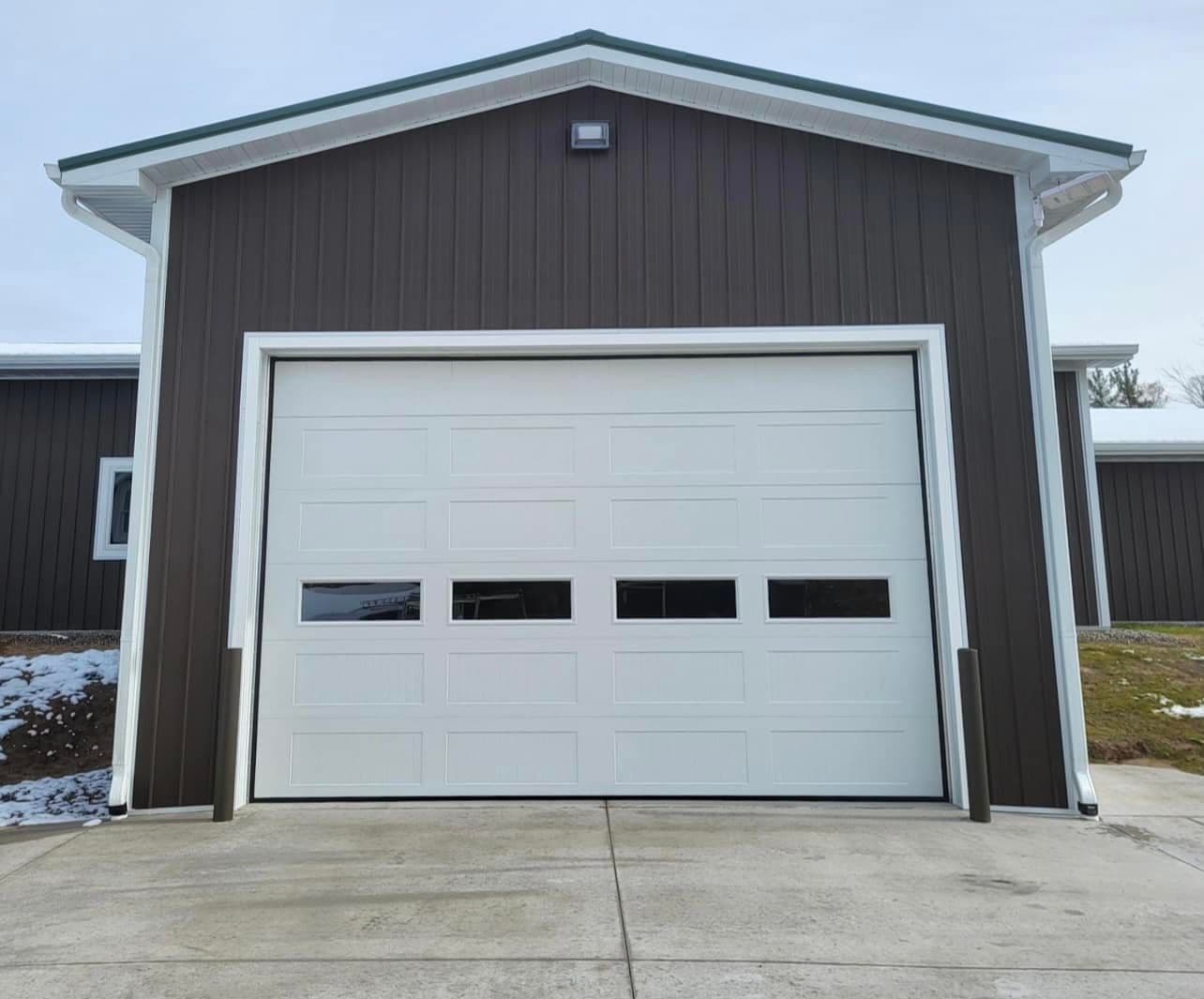
| Heated pole barn or commercial shop | Insulated sections sized to the opening | A big door is a big share of the wall |
| Detached garage with no heat | Polystyrene or a two layer door | Adds stiffness and dent resistance at lower cost |
| Cold storage shed or barn | Non-insulated steel | Nothing inside needs to stay warm |
| Unheated now but heat is planned | Insulated from the start | Saves replacing the door later |
Why do seals and installation matter as much as the number
Seals and installation matter because heat leaves a garage through gaps and metal paths as well as through the foam. DASMA notes that section joints, stiles and other parts of a door can give heat a thermal shortcut around the insulation, while thermal breaks and weather seals resist it. None of that shows up in a calculated R-value.
Wayne Dalton, another national manufacturer, is blunt about it: large gaps between the door and the walls can leave even a well-insulated door useless for energy efficiency, and properly fitted seals, weatherstripping and hardware reduce the loss. The Department of Energy makes the same point about houses in general, crediting savings to adding insulation and reducing unwanted air leaks together.
You can check your own door in a few minutes without touching any hardware.
- 1Close the door on a bright dayTurn the garage lights off and stand inside with the door fully down.
- 2Look for daylight at the floorLight under the door means the bottom seal is flattened, cracked or not meeting an uneven slab.
- 3Check both sides and the topThe perimeter weatherstrip should press lightly against the face of the door all the way around.
- 4Look between the sectionsLight at a joint points to a damaged section, a loose hinge or a door that is not sitting square.
- 5Feel for drafts on a windy dayRun a hand near the corners and the bottom. Moving air tells you more than any label.
- 6Write down what you foundBring the list to a garage door tune-up. New seals are a small job next to a new door.
Do windows and thermal breaks change how warm a door is
Yes. A thermal break helps and windows usually cost a little warmth, which is why both belong in the comparison. A thermal break is an insulating barrier that keeps the inside and outside steel from touching, so cold cannot travel straight through the metal.
Haas Door says a rigid vinyl thermal break separates each of its door sections to eliminate metal-to-metal contact and the transfer of temperature. Haas also publishes tested U-factors for its doors, which is the number DASMA says to trust most.
Windows bring daylight into a garage that sees little of it in December, and Wayne Dalton notes they can also be a source of energy loss. If you want glass, ask about insulated glass. Our new garage door buyer's guide walks through styles, materials and window layouts.
Can you add insulation to the garage door you already have
You can, but a board fitted to the back of a section is not the same as foam bonded between two steel skins, and anything you add changes the weight the springs were matched to. DASMA's inspection checklist says safe operation of the door and opener depends on a balanced door, so added weight is a balance question before it is a comfort question.
If panels have already been added to your door, run our garage door balance test with the door closed and the opener released. A door that drops or feels heavy needs a technician. If the door is dented, rusted at the bottom or missing its seals as well, our guide on whether to repair or replace a garage door will help you weigh a new insulated door against patching the old one.
What does a Northern Michigan winter ask of an insulated door
Up here an insulated door has to hold heat, shed wind and keep blowing snow out at the floor. Traverse City often sees more than 100 inches of lake-effect snow in a season, and wind off West Grand Traverse Bay and East Bay pushes it into any gap at the bottom seal.
In town the needs split by neighborhood. The narrow detached garages in Slabtown, Old Town and the Central Neighborhood mostly need a stiff, well-sealed door. The attached two and three car garages in Garfield Township share walls with kitchens and bedrooms, so a polyurethane door pays off every cold morning. We handle both as part of garage door repair and replacement in Traverse City.
Out on the Leelanau Peninsula the wind is the bigger test. Homes near Fishtown and along M-22 in Leland sit with little shelter from Lake Michigan, and a stiffer insulated section flexes less when a gust hits it. Around Big Glen Lake and Little Glen Lake in Glen Arbor, many garages belong to cottages closed from fall to late spring, where seals dry out and crack while nobody is watching. We cover the rest of Leelanau County too.
How do you compare insulated garage door quotes honestly
Compare quotes on construction and seals, not on one number. Two doors with the same printed R-value can be built very differently, and a calculated section value from one maker cannot be set against a tested U-factor from another.
We install doors from Haas Door, Safe-Way Door, Richards-Wilcox, Asta America and Eden Coast, and we are glad to put spec sheets side by side at the estimate. Ask every company these questions and write the answers down. You can see how we put a new door together on our new garage doors and operators page, and the same questions apply to the tall doors on our pole barn garage doors page.
- Is the thermal number a calculated section R-value or a tested U-factor?
- Is the foam polyurethane or polystyrene, and how thick is the section?
- Is it a two layer or three layer door, and is there a thermal break between sections?
- What bottom seal and perimeter weatherstrip are included, and are they new?
- If there are windows, is the glass insulated?
- Will the springs and opener be matched to the weight of the new door?
Sources
- 1.Technical Data Sheet #163: U-factor and R-value for Residential and Commercial Garage Doors · DASMA
- 2.Consumer Guide to Home Insulation · U.S. Department of Energy
- 3.About Haas Door · Haas Door
- 4.Insulated Garage Doors for Cold Climates · Clopay
- 5.Benefits of Garage Door Insulation · Wayne Dalton
- 6.Residential Sectional Garage Door and Electric Operator Checklist (TDS 167) · DASMA
Free estimate
Have our crew take a look
One short form and our office calls you back during business hours. Most repairs are finished on the first visit, and every truck rolls out stocked.
Or call the office(231) 360-5442Mon to Fri · 7:30 am to 4:00 pm · Closed weekends
Request service
About a minute. Our office calls you back.