New Doors & Openers
How to choose the right garage door for a pole barn
· 11 min read · From the B&B Garage Doors office, Traverse City
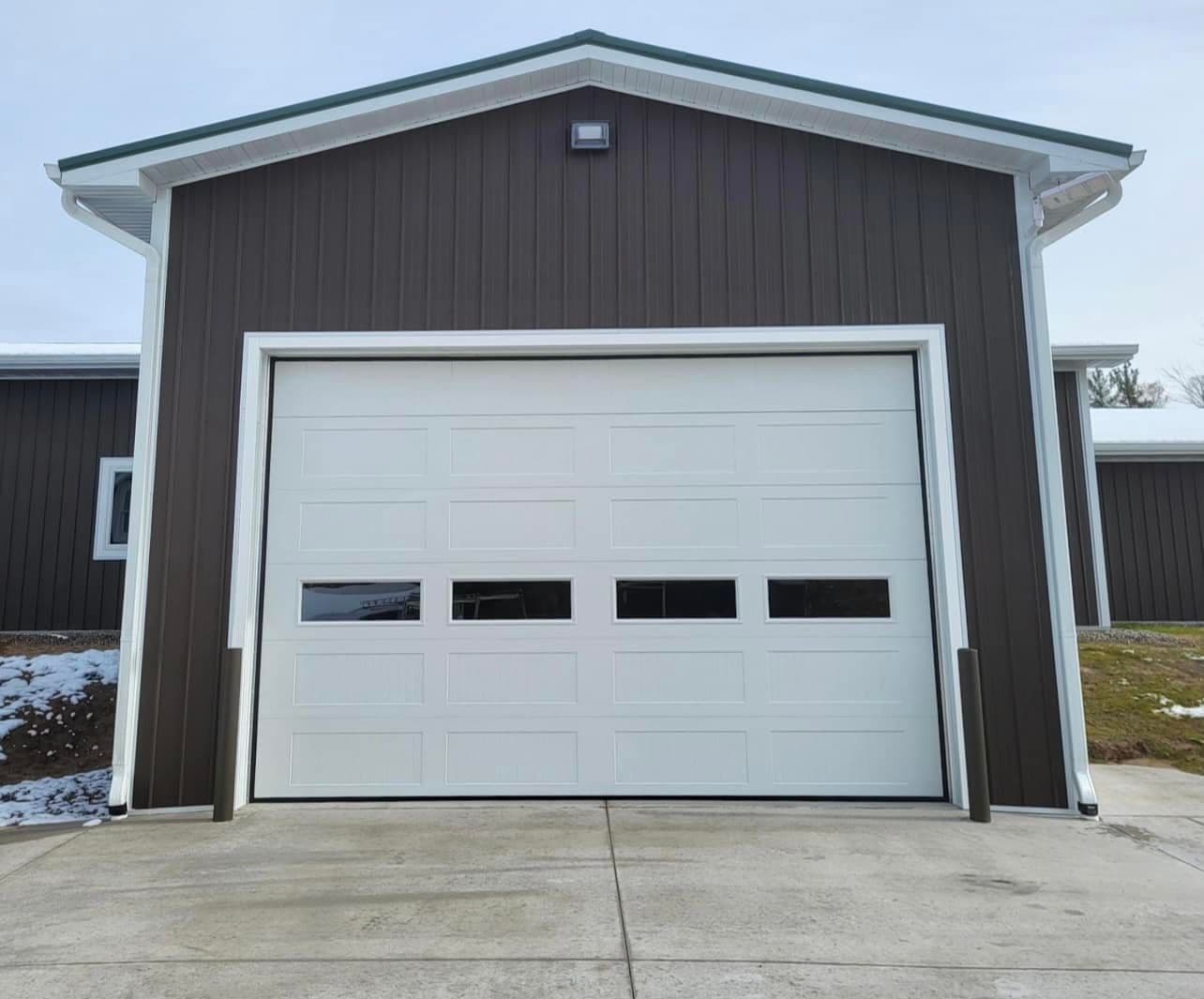
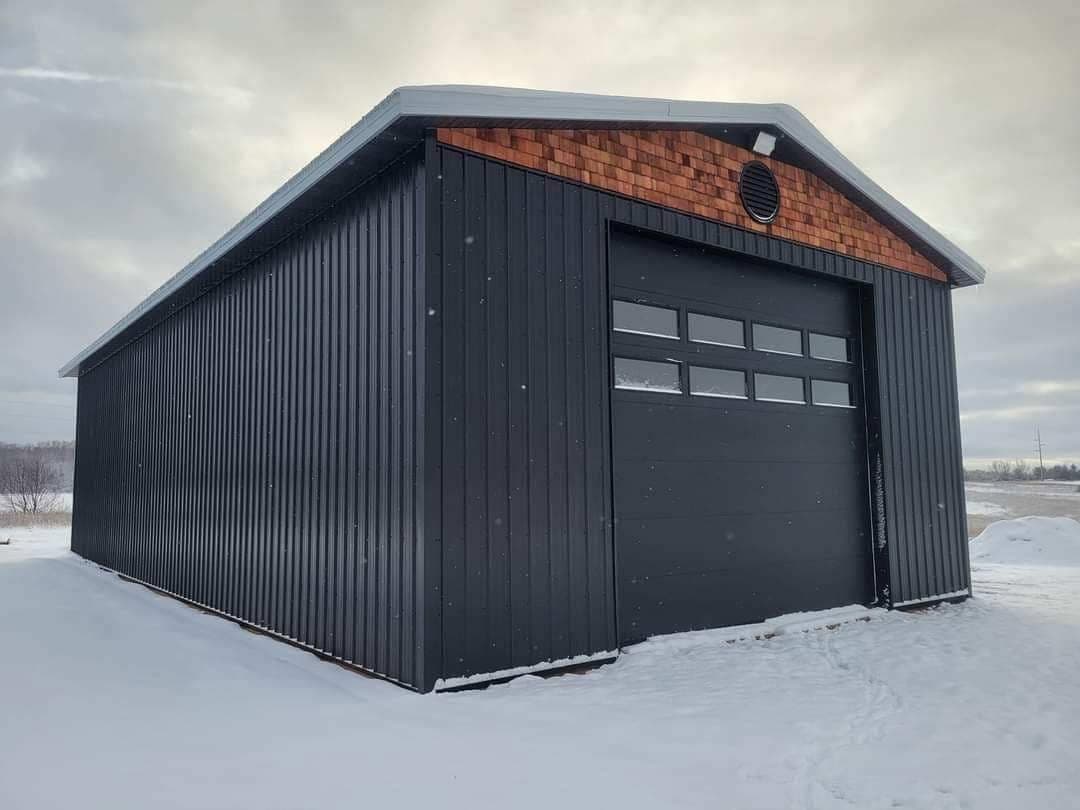
The right pole barn garage door is sized to the tallest and widest thing you will park inside with clearance to spare. Then match it to the building: track that fits the headroom, insulation if the barn is or will be heated, bracing for wind and an opener rated for the door. Settle it before the opening is framed.
Framing a pole barn door opening soon?
Call the office · Mon to Fri · 7:30 am to 4:00 pm · Free estimates
What should you decide before you order a pole barn garage door
Decide what the door has to clear, whether the building will ever be heated and how much room the framing leaves around the opening. Those three answers set the door size, the insulation, the track and the opener, in that order.
Work through these steps for a pole barn garage door while the plans are still on paper. Changing an opening after it is framed is always harder.
- 1Measure the biggest thing you ownTake the height at the tallest point and the width at the widest point, with mirrors out and everything mounted on the roof included.
- 2Think one purchase aheadIf a bigger camper, boat or tractor is likely in the next few years, size the opening for that one.
- 3Decide heated or coldA heated shop wants an insulated door and good seals. True cold storage can use a non-insulated door.
- 4Check the space around the openingNote the distance from the top of the opening to the lowest truss or brace, the wall space on each side and the clear depth back into the building.
- 5Choose the track and the opener togetherThe track layout decides where the open door sits, and that decides which opener will work.
- 6Call before the framing goes upWe will tell you what the door needs from the header, the jambs and the ceiling while it is still easy to change. Estimates are free.
How big should a pole barn garage door be
Big enough for the tallest and widest thing you will ever pull through it, with enough clearance that you are not inching in. There is no single right size, because a plow truck, a pontoon on its trailer and a fifth-wheel camper all ask for something different.
Measure height at the true high point: the roof air conditioner or antenna on a camper, the tower or top on a boat with the trailer under it, the cab or roll bar on a tractor. Measure width with the mirrors out, and remember that you rarely back a trailer in perfectly straight.
Sometimes the best answer is two doors: a tall one for the camper and an ordinary one for daily trips with the mower. This chart pairs common uses with what to measure and the door and track that usually suit them.
| What lives in the barn | What to measure | Door that usually fits | Track and opener notes |
|---|---|---|---|
| Pickup or plow truck | Height with the plow raised and any light bar, width with mirrors out | Sectional door wide enough to back in at an angle | Standard lift track with a ceiling or wall-mount opener |
| Boat on its trailer | Tallest point on the trailer, such as a tower, top or windshield, and width at the fenders | A taller door with room to spare | High lift track if the ceiling height allows it |
| RV or camper | Roof air conditioner, antennas and ladder, plus width with mirrors out | A tall door, insulated if the barn is heated | High lift track and a wall-mount opener keep the ceiling clear |
| Tractor and implements | Cab or roll bar, the loader the way you travel with it and the widest implement | A wide door with reinforcing struts | An opener rated for the door's size and weight |
| Sleds, side-by-sides and trailers | Trailer width and loaded height | A second ordinary door for daily use | Standard lift track and an outdoor keypad |
| Heated shop with a vehicle lift | Lift height with a vehicle raised | Insulated door with good bottom and perimeter seals | High lift or vertical lift track carries the door up the wall |
| Cold storage only | The biggest item going in | Non-insulated steel door | Standard lift track, opener optional |
How much headroom does a pole barn garage door need
It depends on the door's height and weight, the track type and the spring setup, so there is no single number that fits every barn. What matters is that you measure three clearances, not only the opening.
DASMA, the door manufacturers' association, defines them in its sectional door terminology sheet. Headroom is the vertical clear space above the door opening and below the lowest ceiling obstruction. Sideroom is the horizontal measurement from each side of the opening out to the nearest obstruction. Backroom is the horizontal distance into the building from the door mounting surface to the first obstruction.
In a pole barn, trusses, purlins and bracing can crowd that space. Standard track needs more room above the opening than low-headroom hardware does. Low-headroom hardware exists for tight spots, but it has to be planned with the door and it limits which openers will work.
Should a pole barn door use standard high lift or vertical lift track
Use standard lift when the ceiling is not much taller than the door, high lift when there is wall above the opening you want to use, and vertical lift when the wall is tall enough to hold the whole door.
- Standard lift: the door turns onto horizontal track just above the opening and parks along the ceiling.
- High lift: DASMA defines high lift track as track and hardware that make the door rise vertically some distance above the top of the opening before it levels out. The open door sits higher, clear of a vehicle lift or stacked storage.
- Vertical lift: DASMA describes this as a hardware design that opens the door vertically with no horizontal tracks, so the wall above the opening has to be tall enough to hold all of it.
- Contour track: DASMA also lists horizontal track that follows the contour of the roof or ceiling.
Should a pole barn garage door be insulated
Insulate it if you heat the building or think you ever will. For true cold storage a non-insulated steel door is often all you need, and it is lighter and simpler.
An insulated door does more than hold heat. Insulated sections are stiffer against wind and run quieter. Many people build the barn cold and heat it later, and in that case it is usually smarter to put the insulated door in from the start.
When you compare doors, know what the numbers mean. DASMA's sheet on U-factor and R-value explains that an R-value is calculated for a door section only, while a U-factor is tested on the entire installed door, including the joints, hardware and seals. A higher R-value and a lower U-factor are better, the two are not comparable to each other, and DASMA says the tested U-factor gives the highest degree of confidence. Our guide to insulated garage door R-value goes deeper.
How much wind does a big pole barn door have to handle
More than a house door in most cases, because it is a larger surface and pole barns tend to sit on open ground. A door is rated for wind pressure, not wind speed, and the pressure a given door must resist depends on the site and the building as well as the door.
DASMA's wind load FAQ lists door size, mean roof height, building geometry, the door's location on the building and the exposure category among the factors. It describes Exposure B as urban, suburban and wooded areas, Exposure C as open terrain with few obstructions and Exposure D as flat, unobstructed areas and water surfaces. A given wind speed produces the least pressure in Exposure B and the most in Exposure D.
DASMA is clear that the building department with authority in your area is the final word on the wind load a door has to meet, so ask your building official or your builder before you order.
Wide doors are reinforced for this. DASMA defines a strut as a stiffener that reduces deflection of the door sections and increases the door's wind load capability.
What opener works best on a tall pole barn door
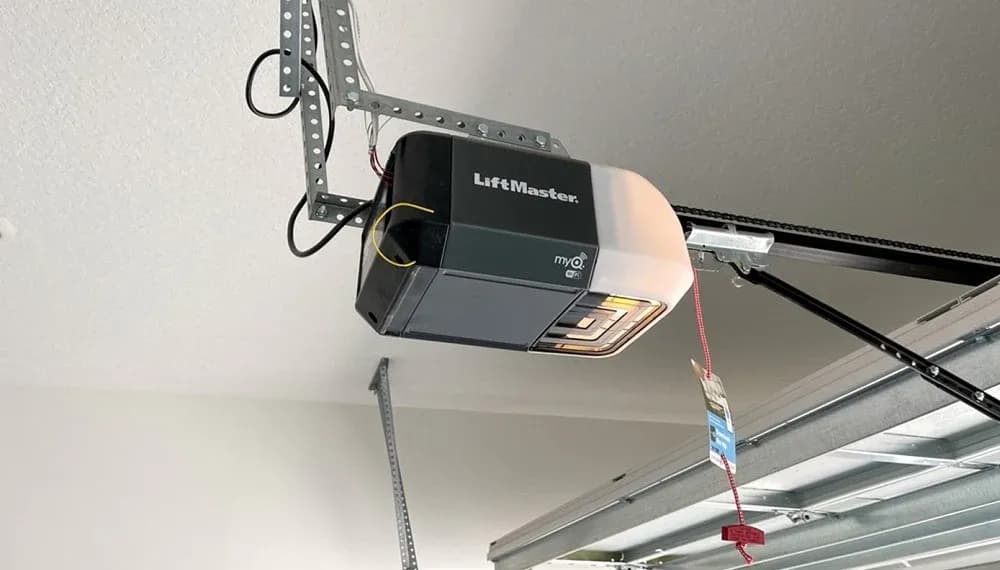
A wall-mount opener, also called a jackshaft, suits many tall doors because it turns the torsion shaft from beside the door and leaves the ceiling clear. A ceiling-mounted trolley opener still works well on a standard lift door of ordinary size.
Wall-mount openers have limits, and they are worth knowing before you plan around one. LiftMaster's manual for its 8500W wall-mount opener says it is for sectional doors with torsion assemblies only. It lists high lift up to 54 inches and standard lift doors up to 14 feet high, up to 18 feet wide and up to 180 square feet, and it says the opener is not intended for low-headroom tracks with an outside pickup drum or for doors with extension springs. A door beyond those limits, or one that runs constantly, may call for a commercial-duty operator.
Track matters here too. A DASMA technical sheet on jackshaft operation explains that a jackshaft moves the door by turning the shaft, which depends on the cables staying tight, and that cable tension on standard lift track is at its lowest when the door is open. It says a jackshaft on a standard lift door should only be set up according to the door and operator manufacturers' instructions.
We install LiftMaster and Linear garage door openers matched to the door. Out in the country, battery backup and an outdoor keypad are worth a look.
How should the opening be framed for an overhead door
Frame it so there is solid structure wherever the door hardware lands: both jambs, the header and the wall above the opening where the track and springs mount. A post-frame wall has posts and girts where a house has studs, so that backing has to be planned in.
DASMA's terminology sheet lists jamb extensions, framing that carries the jambs above the opening height, as required to support door track and spring assemblies.
Wind load travels through the door into those jambs. DASMA publishes a sheet on connecting garage door jambs to building framing, with fastener spacing for wind loads from 10 to 60 pounds per square foot, and it recommends professional engineering advice on the attachment. Its wind FAQ adds that the structure the jambs attach to is the general contractor's responsibility. Bring your builder and your door company into the same conversation early, and have your electrician put an outlet where the opener will mount before the walls are closed in.
What do pole barn doors face in Northern Michigan
Snow, drifting wind and long cold stretches, mostly on open inland ground away from the milder air along the bay. That shapes what we recommend for barns across Grand Traverse County and Kalkaska County.
Around Kingsley, out M-113 through Paradise Township and toward Mayfield, farm and equipment doors are wide and tall and see tractor and trailer traffic. Near Grawn, wind across the open fields along US-31 and Silver Lake Road packs drifts against doors. In Kalkaska, where US-131 and M-72 cross and the snowmobile and ORV trails run through the county, barns hold sleds, trailers and machines as often as cars.
Around Williamsburg, away from Elk Lake and Lake Skegemog, Whitewater Township is wooded parcels and small farms with a pole barn or detached shop. Near Fife Lake, where M-186 meets US-131 in state forest country, weekend and hunting places have barns that sit closed for long stretches with trailers and equipment inside.
Sliding barn doors can freeze in their tracks or get buried, while an overhead door with a good bottom seal opens with a button once the opening is cleared. Always clear drifted snow and ice from the bottom of the door before running the opener. Pushing a heavy door against a drift strains the opener and can pull the door out of its track.
Who repairs the pole barn door you already have
We do. Big outbuilding doors break the same ways home doors do: springs, cables, rollers, track and openers. If a barn door has started to sag, bind or drop, stop running it and call the office.
Every truck rolls out stocked, and most repairs are finished on the first visit. For a new door, use the form on this page and we will set up a free estimate.
Sources
- 1.TDS 160: Sectional Garage Door Terminology · DASMA (Door & Access Systems Manufacturers Association)
- 2.TDS 1501: Standard Lift Garage Doors with Jackshaft Operation · DASMA (Door & Access Systems Manufacturers Association)
- 3.TDS 168: Wind on Garage Doors: Frequently Asked Questions · DASMA (Door & Access Systems Manufacturers Association)
- 4.TDS 163: U-factor and R-value for Residential and Commercial Garage Doors · DASMA (Door & Access Systems Manufacturers Association)
- 5.TDS 161: Connecting Garage Door Jambs to Building Framing · DASMA (Door & Access Systems Manufacturers Association)
- 6.Model 8500W Wall Mount Wi-Fi Garage Door Opener Owner's Manual · LiftMaster
Free estimate
Have our crew take a look
One short form and our office calls you back during business hours. Most repairs are finished on the first visit, and every truck rolls out stocked.
Or call the office(231) 360-5442Mon to Fri · 7:30 am to 4:00 pm · Closed weekends
Request service
About a minute. Our office calls you back.