Winter & Weather
Why your garage door keypad stops working in the cold
· 11 min read · From the B&B Garage Doors office, Traverse City
A garage door keypad that stops working in the cold almost always has a weak battery. Cold slows the chemistry inside the battery, so a keypad that worked in October goes dim in January. Put in a fresh battery first. If the wall button works and the keypad and remotes do not, check lock mode, then the programming.
Locked out by a dead keypad?
Call the office · Mon to Fri · 7:30 am to 4:00 pm · Free estimates
Why does a garage door keypad stop working in the cold
A keypad stops working in the cold because its battery cannot deliver power as quickly at low temperatures. The keypad lives outside on the door frame all winter, so its battery is the coldest one in the whole system.
Energizer explains the chemistry in its alkaline battery handbook. A battery's performance depends on how fast water and ions can move and react inside it, and as the temperature drops that movement slows and performance drops with it. Energizer gives the recommended operating range for alkaline batteries as minus 18 to 55 degrees Celsius, which is about 0 to 131 degrees Fahrenheit.
The important part is that the battery is not ruined. Energizer says no capacity is actually lost to cold. It is only harder to reach, and its example is a flashlight left in a car on a very cold night: dim when used cold, back to normal after it warms up indoors for several hours. A keypad or a visor remote behaves the same way, which is why one that fails at dawn may work again by afternoon.
Chamberlain, the company behind LiftMaster, says a depleted battery is the most common reason a keyless entry stops working while the wall control still does.
What do keypad and remote symptoms mean in cold weather
What the keypad, the remote and the opener lights do will tell you where to look. Start by pressing the wall button inside the garage. If the door runs normally from there, the opener and the door are fine and the problem is in the keypad, the remote or a setting.
| What you notice | Likely cause | What to try | Call us? |
|---|---|---|---|
| Keypad stays dark or dim | Weak or dead keypad battery | New 9V alkaline battery | If it stays dark with a fresh battery |
| Keypad lights but the door does not move | PIN needs programming again or a worn key | Reprogram and try a different PIN | If programming will not take |
| Keypad or remote closes the door but will not open it | Expired temporary PIN or an LED bulb in the opener | Reprogram the keypad or change the bulb | If neither helps |
| Remote only works close to the door | Weak remote battery or interference | New battery then check the opener bulbs | If range stays short |
| Wall button works but nothing else does | Lock mode is on | Hold the Lock button on the wall control | Rarely |
| Every remote and the keypad quit at once | Memory erased or interference | Reprogram each one | Yes if they still fail |
| Nothing works including the wall button | No power or an opener fault | Check the outlet and breaker | Yes |
How do you tell lock mode from a dead battery
If the wall button works and every remote and the keypad fail together, suspect lock mode before batteries. Lock mode shuts them all out at once.
Chamberlain's remote troubleshooting page says that when lock mode, also called vacation mode, is enabled the opener ignores remote control commands. The signs it lists are the opener lights flashing when a remote button is pressed and the command light on the wall control flashing continuously. To turn it off, press and hold the Lock button on the wall control until the indicator stops flashing or becomes solid.
If you are locked outside, Chamberlain's advice is simply to use another entry door to reach the wall control. Our guide to why a garage door won't open covers the cases where the wall button does nothing either.
How do you change a garage door keypad battery
Slide the cover off the bottom of the keypad, swap the battery and test your PIN. Chamberlain's keypad battery guide says most of its keypads take a 9V battery, and its troubleshooting pages note that some older models use a 12-volt.
Chamberlain is specific about the battery: use only alkaline batteries, choose a high-quality 9V alkaline for best performance and do not mix old and new batteries. The signs of a low battery are keypad lights that dim or stop flashing. The steps below follow Chamberlain's instructions for LiftMaster and Chamberlain keypads. Other brands differ, so check your manual.
- 1Find the model numberChamberlain says it is on the back of the keypad or inside the battery compartment. The cover comes off differently from model to model.
- 2Remove the coverOn many models the cover slides down and off. Others release with a flat-head screwdriver pressed into a cutout at the top of the cover, a Phillips screw at the bottom or a small pin hole at the bottom.
- 3Swap the batteryPull the old battery out, disconnect it from the power leads and connect a new 9V alkaline battery. Set it back in the housing.
- 4Close it upSlide the cover up until it clicks or locks.
- 5Check the lightsPress a key. The keypad should light up when pressed.
- 6Enter your PINChamberlain says to re-enter your PIN to confirm the keypad is talking to the opener. If the door does not move, the keypad needs to be programmed again.
Why does the remote only work close to the door in winter
A remote that only works from the end of the driveway, or only from right under the opener, usually has a weak battery, and cold makes a weak battery weaker. Chamberlain says a weak or dead battery can prevent the remote from transmitting a signal.
Its instructions are to remove the battery cover, inspect the contacts for corrosion or damage and install a new 3V CR2032 battery matching the polarity markings. Check what your remote takes before you buy.
A remote clipped to the visor of a car parked outside sits at the same temperature as the keypad. Going by Energizer's flashlight example, bringing it indoors on the coldest nights lets it warm back to normal performance. If a fresh battery does not bring the range back, interference is the next suspect.
How do you reprogram a keypad or remote after a battery change
Reprogram it from the Learn button on the opener. Chamberlain's keyless entry troubleshooting page says a keypad may need its PIN programmed again after a battery change, and that if this does not work the next step is to clear the opener's memory and program the keypad again. Clearing the memory erases the remotes too, so every remote then has to be programmed again.
For a remote, Chamberlain's method on any compatible opener is short: press the Learn button on the motor unit once and release it right away so its light glows steadily, then within 30 seconds press and hold the button on the remote. The opener lights flash or you hear two clicks when it takes. Keypad steps depend on the model and the color of the Learn button, so use the manual for yours.
One warning from Chamberlain is worth knowing. Pressing and holding the Learn button until its light goes out erases every programmed remote and keyless entry, which is how a whole household of remotes quits at once.
- If the keypad lights but the door will not move, program a completely different PIN. Chamberlain says that if the new PIN works, one of the number keys in the old PIN has stopped working.
- A temporary PIN that has expired can still close the door but can no longer open it. Chamberlain's fix is to clear the memory and program the keypad again.
- If the keypad only works when you take it off the wall, the mounting surface is interfering. Chamberlain suggests rubber grommets behind it or mounting it on a small piece of wood.
Can LED bulbs in the opener shorten remote range
Yes, some can. Chamberlain's light bulb guide says to avoid low-quality LED bulbs, which can interfere with the operation of remote controls. It is not a cold weather fault, but it gets blamed on the cold when it shows up in winter.
Chamberlain lists three signs of a bulb the opener does not get along with: a remote that works only up close, a remote or keypad that closes the door but will not open it and trouble programming a new remote or keypad. If those problems started after an LED bulb went in, its advice is to replace the bulb with a compact fluorescent or with the LED bulb Chamberlain has tested for its openers.
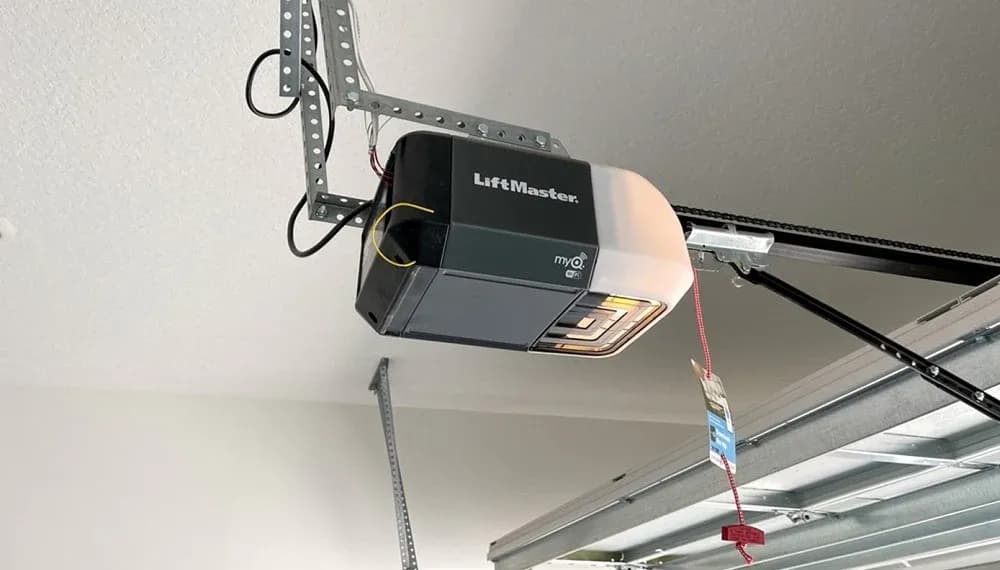
The same page says a bulb should not exceed the size and wattage in your manual, and that bulbs other than those recommended may damage the opener. You can see the LiftMaster and Linear openers we install on our garage door openers page.
When is the opener receiver or logic board the problem
Suspect the opener when fresh batteries, lock mode and reprogramming have all been ruled out. Chamberlain says that if the keypad battery has already been replaced, the keyless entry itself or the receiver logic board in the opener may have failed.
The pattern helps sort it out. One device failing while the others work points at that device. Chamberlain says that when all remotes fail at once or work off and on, signal interference is a likely cause. When programming will not take on any remote or keypad, the part of the opener that listens for them is the suspect, and that is work for garage door opener repair. On an older unit, our guide on whether to repair or replace a garage door opener helps with the decision.
- The keypad stays dark with a new battery. The keypad has likely failed.
- The keypad and remotes all light up and the opener ignores every one, with lock mode off.
- A remote will not program even with the Learn light on and a fresh battery.
- The door moves when nobody pressed anything. Our guide to a garage door that opens by itself covers that one.
Why do keypads and remotes quit so often on the Leelanau Peninsula
On the Leelanau Peninsula the usual reason is a battery that sat outside through months of cold with nobody home to notice it fading. Many homes there are summer places closed from fall until the next season, and the keypad is the first thing an owner touches on the first trip back.
In Suttons Bay, up M-22 along West Grand Traverse Bay, and out M-204 toward Lake Leelanau, a garage door that sits through a Leelanau winter can come back with an opener that will not respond. Fresh batteries in the remote and the keypad are the first thing to try.
In Leland, between Lake Michigan and the north end of Lake Leelanau, there is little shelter from the big lake. Wind off Lake Michigan brings snow, cold and damp air at homes near Fishtown and along the Leland River, which is a good reason to look at the battery contacts for corrosion when you change a battery. We cover the rest of Leelanau County too.
In Traverse City, the detached garages in Slabtown, Old Town and the Central Neighborhood often sit back on the lot or off an alley, so the keypad is how people get in without walking through the house.
How do you keep a keypad and remote working all winter
Change the batteries before the cold, keep one way in that does not depend on a battery and fix small problems while the weather is mild. Our guide to the best garage door opener for cold weather covers the rest of the fall checklist.
- Put a new 9V alkaline battery in the keypad every fall, even if it still lights up.
- Keep a spare remote battery in the house, not in the cold car.
- Test the keypad now and then, because a control that is rarely used can fade unnoticed.
- Carry a house key in winter. A keypad should never be the only way in.
- Use a bulb your opener's manual allows, and change it if remote range drops after a new bulb goes in.
Sources
- 1.Alkaline Manganese Dioxide Handbook and Application Manual · Energizer
- 2.The Wall Control Panel Works but the Keyless Entry Does Not · Chamberlain Group
- 3.Remote Control: Remote Does Not Work · Chamberlain Group
- 4.Wireless Keypad: How to Change the Battery · Chamberlain Group
- 5.How to Program a Remote Control to a Garage Door Opener · Chamberlain Group
- 6.Light Bulbs That Can Be Used in Garage Door Openers · Chamberlain Group
Free estimate
Have our crew take a look
One short form and our office calls you back during business hours. Most repairs are finished on the first visit, and every truck rolls out stocked.
Or call the office(231) 360-5442Mon to Fri · 7:30 am to 4:00 pm · Closed weekends
Request service
About a minute. Our office calls you back.