Winter & Weather
What makes the best garage door opener for cold weather
· 11 min read · From the B&B Garage Doors office, Traverse City
The best garage door opener for cold weather is one matched to a balanced door: a belt drive with battery backup for most attached garages, a chain drive for detached garages and barns, or a wall-mount unit for tall doors. Cold stiffens grease and drains remote batteries, so the door's condition matters more than motor size.
Opener struggling in the cold?
Call the office · Mon to Fri · 7:30 am to 4:00 pm · Free estimates
What is the best garage door opener for cold weather
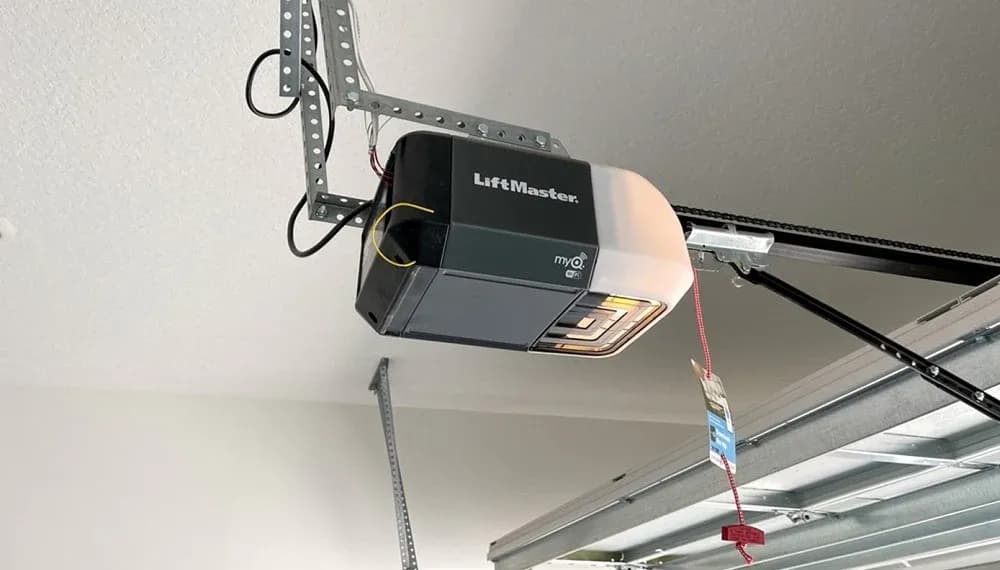
For most attached garages in Northern Michigan the best cold weather opener is a belt drive with battery backup, installed on a door that has been balanced first. For a detached garage or pole barn a chain drive is a dependable choice, and for a tall door or a ceiling you want clear, a wall-mount opener is the better fit.
None of those is a winter model. Cold affects the grease, the springs and the small batteries far more than the motor, so the features that matter are the ones that keep you moving when the power is out and the door is stiff. We install LiftMaster and Linear openers, and you can see the lines on our garage door openers page.
If your current opener is acting up and you are deciding whether to keep it, start with our guide on whether to repair or replace a garage door opener. This article picks up where that one ends: what to choose, and what to check, for a long winter.
What does cold weather do to a garage door opener
Cold makes the door harder to move and weakens the batteries that send the signal, and the opener gets blamed for both. The motor itself is rarely the weak point.
Here is what actually changes when the temperature drops.
- Lubricant stiffens. Clopay's cold weather guide says lubricant can harden and get gunky as the temperature drops, so the door drags or sticks at one spot in the track.
- Metal parts tighten up. Genie notes that cold can cause metal parts to contract, which shows up as squeaky hinges and a sluggish door.
- Springs get brittle. Clopay says spring wire becomes more brittle and weakens in colder temperatures, which is why broken springs are more common in winter. A weak spring leaves the opener lifting weight it was never meant to carry.
- Remote batteries fade. Genie warns that cold weather can drain a remote battery quicker and suggests replacing it before it is dead so you are not stuck outside.
- Keypad batteries fade faster. An outdoor keypad lives in the cold, and Genie says its batteries can drain faster there, especially on a keypad that is not used often.
- The seal freezes down. Meltwater under the bottom seal can freeze the door to the floor, and running the opener against it strains the opener and can tear the seal.
Which opener drive type handles cold weather best
No drive type is immune to cold, but belt, chain and wall-mount openers all run well through a Northern Michigan winter on a door that moves freely. The choice comes down to noise, the size of the door and where the opener can mount.
Older screw drive openers are the one style that needs extra winter care. Genie recommends cleaning and re-lubricating the drive screw with a low temperature lubricant on its screw drive models made before 2010. DC motor and battery backup are not drive types, but they appear on so many current models that they belong in the same comparison.
| Type | What it is | In the cold | Good fit up north |
|---|---|---|---|
| Chain drive | Steel chain pulls a trolley along a ceiling rail | Rugged and dependable but louder | Detached garages, shops and barns |
| Belt drive | Reinforced belt in place of the chain | Quiet, with no chain to rattle through the house | Attached garages near bedrooms and kitchens |
| Wall mount or jackshaft | Mounts beside the door and turns the torsion shaft | No ceiling rail or trolley, but needs a balanced torsion spring door | Tall doors, high-lift track and clear ceilings |
| DC motor | The motor type on LiftMaster's battery backup models | Runs from the backup battery when the power is out | Any garage where outages are common |
| Battery backup | A rechargeable battery inside the opener | Keeps the door working in an outage, with fewer cycles as the battery ages | Rural homes and anyone who cannot lift the door by hand |
Why does door balance matter more than the motor
Balance matters more because the springs lift the door and the opener only guides it. When the springs weaken, the opener has to drag the extra weight, and cold grease adds to the load on the same morning.
Genie's winter checklist includes a simple check: with the door fully closed, release the opener, raise the door 3 to 4 feet by hand and let go. It should move very slowly or stay put. If it closes quickly or opens on its own, it is out of balance and needs a professional. Our garage door balance test guide walks through it step by step.
Manufacturers build this into their requirements. Chamberlain's installation requirements for its wall-mount jackshaft openers state that the garage door must be properly balanced. A bigger motor on an unbalanced door only hides the problem until a spring, a gear or a cable gives out.
Do you need battery backup on a garage door opener up north
If winter storms knock out your power, yes. Battery backup lets the opener run when the house has no electricity, so you are not lifting a heavy insulated door by hand in the dark.
The numbers are modest but useful. Chamberlain, the company behind LiftMaster, says a fully charged battery is designed to give 24 hours of standby time, during which the opener can run up to 20 full cycles at room temperature. That figure is quoted at room temperature, so do not count on the full number in an unheated garage in January. Nice says the built-in battery on its Linear 621 can keep the opener working for up to three days during a power failure.
Backup batteries wear out. LiftMaster says the battery usually lasts one to two years depending on use and care, and that a status light tells you when it needs replacing. On Chamberlain-built openers, a beep every 30 seconds with a flashing orange light means the battery is low, and a solid red light means it can no longer recharge.
Everyone in the house should still know the manual release. Our guide on how to open a garage door manually covers when it is safe and when to leave the door alone.
Which opener features matter most in a Northern Michigan winter
After battery backup, the features worth having are the ones that save a cold walk or a trip back home. These are the ones we point out at an estimate.
- Phone control. The battery backup models LiftMaster lists are Wi-Fi openers, so you can check from anywhere whether the door is closed against the snow.
- Built-in LED lighting. Nice says the Linear 621's integrated LED lighting never needs a bulb replaced, which is welcome on a ceiling you reach by ladder in a cold garage.
- An outdoor keypad. It gets you in when a remote battery quits. Mount it on the side you walk up to and away from where the plow leaves its bank.
- A wall-mount design for tall doors. It turns the torsion shaft directly and keeps the ceiling clear for high-lift track or storage.
- Battery health alerts. Nice says the 621 monitors battery health and charge level and tells you when a replacement is needed.
- A motor sized to the door. A heavy insulated double door asks more of an opener than a light single door, so we size the opener to the door you have.
How do you get a garage door opener ready for winter
Get an opener ready for winter by replacing the small batteries, lubricating the door and testing the backup and safety systems before the first hard freeze. Genie advises unplugging the opener before doing any maintenance on the door or opener.
- 1Replace the remote batteriesGenie suggests changing them as needed or at least every two to three years. Shorter range or a dark indicator light means it is time.
- 2Put a fresh battery in the outdoor keypadDo it in the fall even if the keypad still works. It is the control most likely to fail in the cold.
- 3Lubricate the door hardwareClopay recommends a silicone-based lubricant on the metal parts and warns against WD-40, which can cause problems in cold weather. Skip nylon rollers.
- 4Test the battery backupGenie's method is simple: unplug the opener and run the door from a remote or the wall control. Plug it back in afterward and check the battery light.
- 5Check the balanceWith the door closed, release the opener and lift the door 3 to 4 feet. If it will not hold, stop and call. Do not adjust anything yourself.
- 6Test the safety reverseGenie's checklist includes confirming that the door reverses when it meets an object and that the sensor lights look right.
- 7Keep the threshold clearGenie notes that ice where the seal meets the floor can stop a door from closing fully. Sweep slush away before it freezes.
Which opener suits homes and barns from Kalkaska to Interlochen
Inland from the bay the right opener is usually decided by the building. Away from the milder air along Lake Michigan, winter around Kalkaska runs long, cold and snowy, and the garages there hold sleds, trailers and equipment as often as cars.
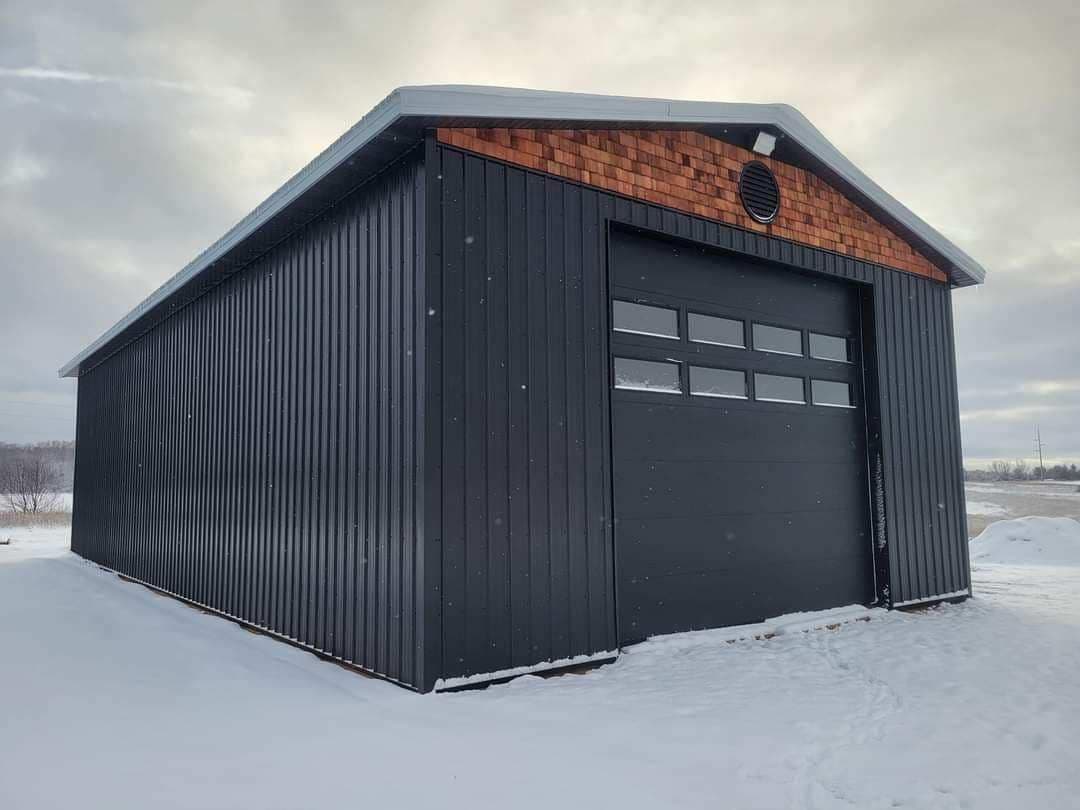
Around Kalkaska, where US-131 and M-72 cross, and across the rest of Kalkaska County, many doors are on pole barns and shops. A chain drive or a wall-mount opener sized to a tall door suits those buildings, and battery backup with an outdoor keypad is worth a look on rural property. Our pole barn garage doors page covers the doors themselves.
In Kingsley, wind across the open fields of Paradise Township packs drifts against doors, and for a village home along M-113 with a garage attached to the house a quiet belt drive makes sense. Around Fife Lake, cottages on the lake and cabins off US-131 and M-186 can sit closed for weeks, so a healthy backup battery and a fresh keypad battery matter when you arrive after dark.
In Interlochen, the small detached garages between Green Lake and Duck Lake see colder nights than the bay shore. Grease thickens and a door that moved easily in October can drag in January, which is a door problem to fix before any opener is chosen.
When is a new opener the wrong fix for a winter problem
A new opener is the wrong fix whenever the trouble is in the door, the batteries or the ice at the floor. Clopay's advice for a door that will not work in the cold is to disconnect the opener with the door closed and try it by hand. If the door moves fine, look at the opener and its remote batteries. If it is heavy or will not move, the door is the problem.
These signs point away from the opener.
- The door feels heavy by hand or will not stay halfway open. That is a spring or balance problem.
- There was a loud bang from the garage. Clopay says a popping noise can be a spring breaking.
- The door is stuck at the floor with ice along the seal. Do not force it with the opener.
- The wall button works but the remote or keypad does not. Start with fresh batteries.
- The door drags at the same spot every time. Hardened lubricant or a worn roller is the likely cause.
Sources
- 1.Winter Garage Door Opener Maintenance Tips · The Genie Company
- 2.Fixing Garage Door Problems from Cold Weather · Clopay
- 3.Why is the Garage Door Opener Beeping · Chamberlain Group
- 4.Garage Door Openers with Battery Backups · LiftMaster
- 5.Jackshaft Opener: Installation requirements for the Residential Jackshaft Openers · Chamberlain Group
- 6.Nice Launches Linear 621 Garage Door Opener · Nice North America
Free estimate
Have our crew take a look
One short form and our office calls you back during business hours. Most repairs are finished on the first visit, and every truck rolls out stocked.
Or call the office(231) 360-5442Mon to Fri · 7:30 am to 4:00 pm · Closed weekends
Request service
About a minute. Our office calls you back.