Repair & Troubleshooting
What each garage door noise means and how to quiet it
· 11 min read · From the B&B Garage Doors office, Traverse City
A noisy garage door is usually asking for lubricant or a wrench. Squeaks point to dry hinges and rollers, rattles to loose hardware and grinding to track or opener trouble. A silicone-based garage door lubricant quiets most doors. A loud bang, popping near the springs or a door that turns heavy means stop and call a technician.
Heard a loud bang from the garage?
Call the office · Mon to Fri · 7:30 am to 4:00 pm · Free estimates
What do the different garage door noises mean
Each noise points to a different part: squeaks to dry metal, grinding to the tracks or the opener's gears, rattles to loose hardware and a bang to something broken. Clopay's guide to noisy garage doors sorts the sounds this way and traces them to two sources, the door itself or the opener.
Run the door once while you stand inside, well clear of its path, and note where the sound comes from and when it happens. Then match it in this chart.
| Sound | What it usually means | Safe to try yourself? | Call us? |
|---|---|---|---|
| Squeaking or creaking | Dry hinges, rollers or springs | Yes, lubricate | If lubricant doesn't quiet it |
| Grinding | A track out of line, worn rollers or worn opener gears | Look only | Yes |
| Popping | Possible spring trouble | No | Yes, and stop using the door |
| One loud bang | A broken spring or broken hardware | No | Yes |
| Rattling | Loose bolts, loose brackets or a slack opener chain | Snug hinge and opener bolts only | If it keeps rattling |
| Humming with no movement | The opener is straining or disconnected from the door | Check the door lock | Yes if a spring is broken |
| Clanging overhead | A loose chain drive or worn opener parts | No | Yes |
Why is my garage door squeaking
Squeaking almost always means moving metal parts have gone dry. Clopay ties squeaks and creaks to parts that need lubrication, and adds that worn rollers or hinges can make the same noise.
The squeak usually comes from one of four places: the hinges that join the door sections, the rollers that ride in the tracks, the springs and the bearing plates at the top of the door. Friction builds up between those parts over time, and the door gets louder as it does.
Squeaky springs sound alarming but often aren't. DASMA, the door manufacturers' association, says springs can squeak and be noisy from normal use and that this does not necessarily indicate a problem. Its advice is to try a spray-on lubricant made for garage doors first and to call a professional if the noise persists.
How do you lubricate a noisy garage door safely
Use a silicone-based garage door spray, put a light coat on the hinge pins, the steel rollers and the springs, and wipe off the excess. Clopay's lubrication guide recommends silicone-based lubricant because it lasts and doesn't attract dirt, and lists white lithium grease as a second option to use sparingly.
The whole job is spraying and wiping. You do not need to loosen, remove or adjust anything.
- 1Close the door and unplug the openerWork with the door fully down, and pull the opener's plug so nobody runs the door while your hands are near the hinges.
- 2Wipe before you sprayClean dirt and old grime off the hinges and rollers with a cloth. Wipe the tracks with a damp cloth and dry them.
- 3Spray the hinge pinsPut a small amount on each hinge pin and wipe away whatever squeezes out. Keep your fingers out of the joints between the door sections.
- 4Spray the steel rollersAim at the bearings in each steel roller. Clopay says not to lubricate nylon rollers, which are typically black or white.
- 5Mist the springs from where you standClopay's guide calls for a light spray along the length of a torsion spring, and on the pulleys of an extension spring system. Spray only. The springs are under high tension, so keep hands and tools off them.
- 6Leave the tracks dryLubricant in the tracks makes it harder for the rollers to move and makes the opener work harder, so keep the spray off them.
- 7Run the door and listenPlug the opener back in and run the door several times to work the lubricant in. If one spot still squeaks, give it a little more.
Why is my garage door grinding
Grinding usually means a track is out of line, the rollers are worn or the gears inside the opener are worn. Clopay says to pay attention when you hear it, because misaligned tracks force the rollers to fight their way along, and both track and gear problems start small and can escalate quickly.
Watch the door run and look for a gap between a roller and the track wall, or a spot where the door seems to stick. That is a track problem. Track position decides whether the rollers stay where they belong, so we treat realignment as a technician's job. Our guide to a garage door that comes off its track shows where a neglected track ends up.
Worn rollers are the other suspect, and Clopay notes that rollers are usually the first parts to wear out. The bottom rollers sit in the bottom brackets, which DASMA says are under extreme tension and should be loosened only by a trained technician, so roller replacement belongs to our garage door repair crew.
If the grinding comes from the motor housing on the ceiling and not from the door, the opener's gears are the suspect, and no amount of spray on the door will change it.
What does a loud bang or popping from the garage door mean
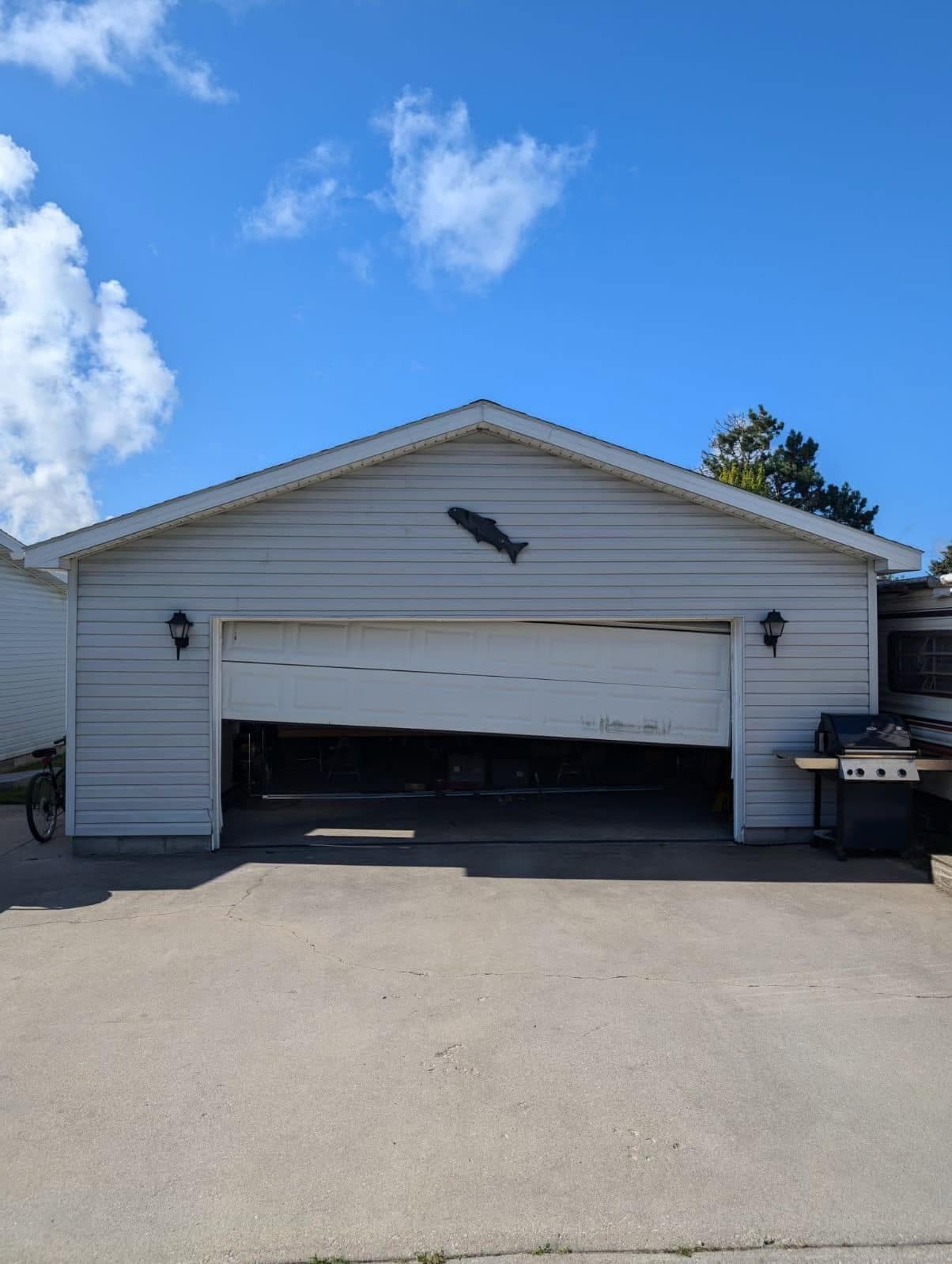
Treat a loud bang as a broken spring until you have looked. Clopay describes a breaking spring as a loud bang that sounds like a car backfiring, and says that if you hear popping sounds or notice broken springs you should call a professional immediately.
Look above the door from a few steps back. A broken torsion spring shows a gap in the coil, and the door will feel far heavier than it should. Loose or broken hardware can bang too, so a bang with no visible gap still deserves a careful look at the hinges, the brackets and the cables at the bottom corners.
If a spring has let go, our guide on what to do when a garage door spring breaks covers the next steps and what to leave alone.
Why does my garage door rattle
Rattling points to loose hardware. Clopay lists the usual sources as bolts that have wiggled free over time, chain drives that need adjustment and mounting brackets that have come loose from the garage framing.
A garage door shakes a little every time it runs, and over the years hinge and track bolts work loose. Snugging up loose hinge and opener hardware with a socket or a nut driver often ends the rattle. Clopay's one caution is not to overtighten, which can damage the door or strip the threads.
Know which fasteners are yours to touch.
- Fine to snug: the bolts and screws that hold the hinges to the door sections.
- Fine to snug: the hardware that fastens the opener and its rail to the ceiling and the wall.
- Leave alone: the bottom brackets at each lower corner of the door, where the cables attach.
- Leave alone: anything on the springs, the shaft above the door, the drums or the cables.
- Leave to a technician: a chain that sags or slaps the rail, and a hinge that will not stay tight.
Why does my garage door opener hum but not move the door
A hum with no movement means the opener is trying to move a door that won't budge, or it has come unhooked from the door. Chamberlain's troubleshooting chart for chain and belt drive openers gives the causes of a brief hum as broken springs, an activated door lock or a trolley stuck at the end of the rail.
Check the lock first, because it is the one cause you can fix by hand. If a slide bolt or lock bar on the door is engaged, release it and try again. If the springs look broken, stop there. Chamberlain's answer for that row of the chart is to contact a trained door technician.
A hum that goes on for about 30 seconds is different. Chamberlain says the door may not be connected to the opener, and you may see only the trolley travel along the rail while the door stays put. Reconnect it with the emergency release only when the door is fully closed.
An opener that hums, clicks or grinds on a door with healthy springs is a job for garage door opener repair.
Why is my garage door louder in a Northern Michigan winter
Cold hardens old lubricant. Clopay's cold weather guide says that as the temperature drops, lubricant can harden and get gunky, so a door stops rolling smoothly or hangs up at one spot in the track. Its fix is to clean off the hardened lubricant and apply a silicone-based one to the metal parts.
Up here that happens every year, and the lake country east of Traverse City adds its own twist. In Acme, where US-31 meets M-72 on the East Arm of Grand Traverse Bay, wind off the open water drives snow and cold straight at the doors along the shore. Some Acme homes are seasonal or rentals, and a door that has sat unused deserves a listen for grinding before it goes back into daily service.
East along M-72, Williamsburg mixes cottages on Elk Lake and Lake Skegemog with rural parcels in Whitewater Township. Doors on lake properties that sit closed through the off season can come back in spring with stiff rollers, and the old door on a pole barn or detached shop tends to keep its rusted hardware longer than it should.
Elk Rapids sits between East Grand Traverse Bay and Elk Lake, with older village homes on compact lots and cottages running up the Chain of Lakes toward Torch Lake. Garages there can stay shut for months with a boat or a trailer inside. We cover the village and the rest of Antrim County from our office south of Traverse City.
Would a new opener or new rollers make my garage door quieter
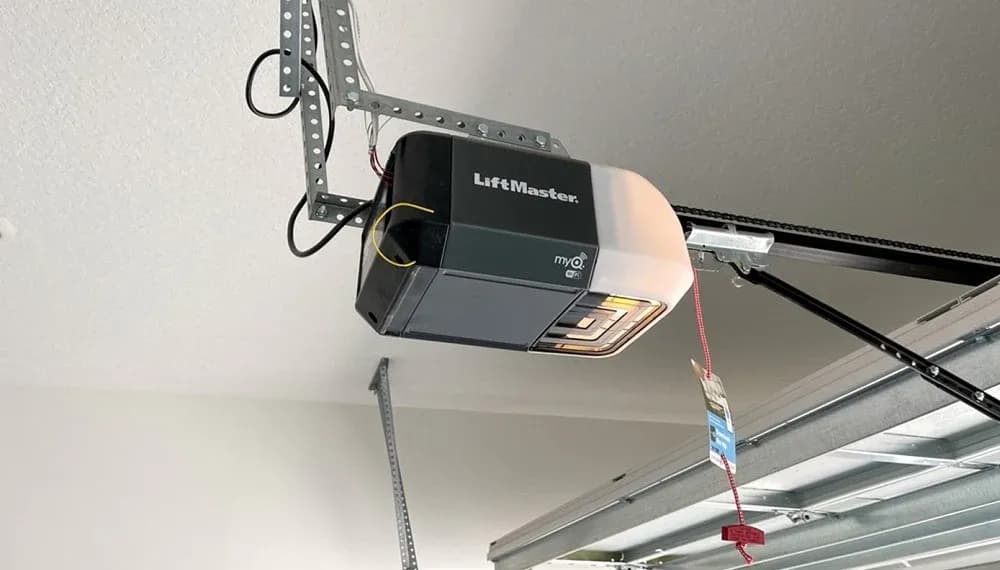
Often, yes. LiftMaster says the difference in sound and vibration between a chain drive opener and a belt drive opener is noticeable, and it pitches its belt drive and wall mount openers at attached garages and homes with living space above the garage.
We install and service LiftMaster and Linear openers, and our garage door opener page compares the drive types. A wall mount opener sits beside the door and skips the ceiling rail altogether, and LiftMaster says the wall mount design reduces noise and vibration.
Rollers are the other upgrade. Clopay calls nylon rollers naturally quieter than metal ones and suggests them when the old rollers are worn.
A quiet opener can't hide a noisy door, though. Dry hinges, loose hardware and a door out of balance will sound the same under any motor, so start with a garage door tune-up, where we lubricate the moving parts, tighten the hardware and test the balance.
Which garage door noises mean stop and call
Stop and call for any noise that comes with a change in how the door moves. Clopay's red flags are grinding that won't quit, sudden loud bangs, a door that becomes unbalanced and anything involving springs or cables.
- A loud bang, with or without a visible gap in the spring.
- Popping from the springs or the area above the door.
- Grinding that is still there after you have cleaned and lubricated.
- A door that jerks, sags on one side or suddenly feels heavy.
- A cable that looks frayed or hangs loose at a bottom corner.
- A noise that keeps coming back a few days after lubrication.
Sources
- 1.How to Fix a Noisy Garage Door: Comprehensive Guide for Homeowners · Clopay
- 2.How to Properly Lubricate Your Garage Door Components · Clopay
- 3.Fixing Garage Door Problems from Cold Weather · Clopay
- 4.Garage Door Safety Tips · DASMA (Door & Access Systems Manufacturers Association)
- 5.Why does my garage door opener hum but the door does not move · Chamberlain Group
- 6.Quiet Garage Door Openers · LiftMaster
Free estimate
Have our crew take a look
One short form and our office calls you back during business hours. Most repairs are finished on the first visit, and every truck rolls out stocked.
Or call the office(231) 360-5442Mon to Fri · 7:30 am to 4:00 pm · Closed weekends
Request service
About a minute. Our office calls you back.