Winter & Weather
How to winterize the garage door when you close the cottage
· 12 min read · From the B&B Garage Doors office, Traverse City
To winterize a garage door at a seasonal cottage, test the balance and the safety reversal, lubricate the rollers and hinges, check the bottom seal and close the door on a dry floor. Then turn on lock mode at the wall control, put a fresh battery in the keypad and decide whether the opener stays plugged in for the winter.
Closing the cottage this month?
Call the office · Mon to Fri · 7:30 am to 4:00 pm · Free estimates
How do you winterize a garage door at a seasonal cottage
Check that the door works properly, put it away clean and dry, then lock it down and tell whoever watches the place how it is set.
Do it before the final day. If the door fails a test, there is still time to book a repair before the snow flies.
- 1Look the door overFrom inside with the door closed, look at the springs, cables, rollers and hinges without touching them.
- 2Test the balanceWith the door closed, pull the manual release and lift the door by hand. It should move freely and stay put when you stop partway.
- 3Test the safety reversalLay a 2x4 flat under the door and close it with the opener. The door should reverse when it touches the board.
- 4Lubricate the moving partsPut a garage door lubricant on the rollers, hinges and bearings. Wipe the tracks clean and leave them dry.
- 5Check the sealsClose the door and look for daylight along the bottom, sides and top. Cracked, flattened or chewed seals should be replaced before winter.
- 6Sweep and dry the floor lineClear sand, leaves and pine needles from the threshold and the bottom of each track, then close the door on a dry floor.
- 7Turn on lock modeUse the lock feature on the wall control so remotes cannot open the door while the place sits empty.
- 8Sort out power and batteriesDecide whether the opener stays plugged in, put a fresh battery in the outdoor keypad and bring the remotes home.
- 9Brief your caretakerTell whoever checks the cottage how the door is locked, how to get in and what to watch for.
What should you test before you leave for the winter
Test the balance and the safety reversal. They tell you whether the springs and the opener are healthy enough to sit for months and work on the first try in spring.
For the balance test, the U.S. Consumer Product Safety Commission says to make sure the door is closed, pull the quick release to detach the door from the opener and move the door up and down by hand. A properly balanced door stays in place when stopped in any partially open position. DASMA's checklist for home inspectors and consumers asks the same questions: does the door move freely, do the rollers stay in the track and does the door stay put 3 to 4 feet above the floor. Our garage door balance test guide walks through it.
For the reversal test, the CPSC says to place a 2x4 on the floor in the door's path. If the door does not reverse when it strikes the board, the opener should be disengaged until it is adjusted, repaired or replaced. DASMA adds a second check: wave an object through the photo-eye beam as the door closes and confirm the door reverses and returns to fully open.
The CPSC recommends inspecting the door and opener every 30 days. A cottage door misses those checks all winter, which is why the one on the way out matters.
What should you lubricate and what should you leave alone
Lubricate the rollers, hinges and bearings, and leave the tracks clean and dry.
LiftMaster's maintenance schedule calls for oiling the door rollers, bearings and hinges every year and says not to grease the door tracks. Clopay's cold weather guide recommends a silicone-based lubricant on the metal parts, warns against using WD-40 on a garage door because it can cause problems in cold weather, and says not to lubricate nylon rollers, which are typically black or white.
Near the dunes, fine sand works into tracks and rollers. A door that grinds may only need cleaning, lubrication and new rollers, and a fall garage door maintenance visit covers all of that along with the balance and safety tests.
Why should the garage door close on a dry floor
Because a bottom seal that sits in water or wet snow freezes to the concrete. Clopay explains that this is how a door ends up frozen shut: the weatherseal sits in water or wet snow that freezes when the temperature drops.
Sweep the threshold, clear the bottom of each track and let the floor dry before the last close.
Check the seal itself while you are there. The bottom seal and the weatherstripping around the sides and top are what keep wind, snow and mice out, and after a few seasons of sun and cold they crack, flatten and pull away.
Ask whoever plows the drive to keep snow from piling against the door. If the door does freeze down, Clopay says not to force it, which can rip the weatherseal, and not to use ice melt on the door. Our guide to a garage door frozen to the ground covers how to free it safely.
Should you use lock mode on the wall control
Yes, if your wall control has it. Lock mode, sometimes called vacation lock, tells the opener to ignore remote controls, so a lost or stolen remote cannot open the door while the cottage sits empty.
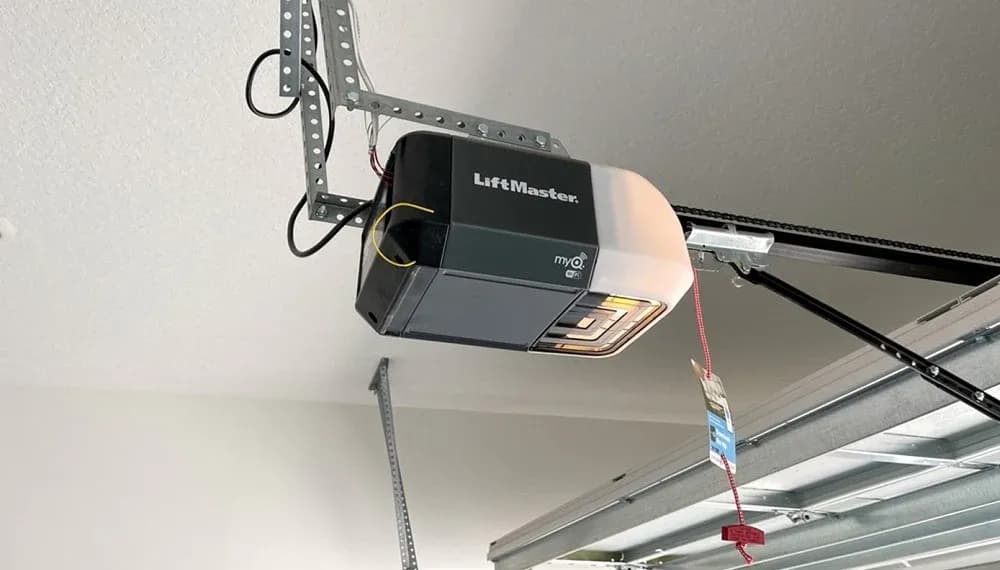
LiftMaster's manual for its 8500W opener says the lock feature is designed to prevent activation from remote controls while still allowing activation from the door control and keyless entry, and calls it useful for peace of mind when the home is empty. On that model it is set from the menu on the wall control. Other wall controls have a dedicated lock button.
Chamberlain's support article on lock mode describes how to tell it is on: the command light on the wall control flashes continuously, and the opener lights flash twice when someone presses a remote. To turn it off, press and hold the lock button until the light stops flashing or goes solid. Chamberlain adds that if you are locked outside, you get in through another entry door and switch it off at the wall control. Models differ, so check your own manual for what lock mode blocks.
| Method | What it does | What to watch for |
|---|---|---|
| Lock mode on the wall control | Opener ignores remote controls | On LiftMaster's 8500W the wall control and keypad still work. Check your model. |
| Opener unplugged | Cuts wall power to the opener | A battery backup keeps the opener running for a while. Smart monitoring stops. |
| Manual slide lock on the door | Bolts the door to the track | Never engage it while the opener can still run. Tell your caretaker it is locked. |
| Automatic door lock accessory | Keeps the closed door from being opened by hand | An add-on for certain openers. LiftMaster says it stays disabled on battery power once the door is opened. |
| Service door deadbolt | Secures the walk-in door | This is the way in for you and your caretaker, so keep the key handy. |
Should you unplug the garage door opener for the winter
It depends on whether you want to watch or operate the door while you are away. Unplugging takes the opener out of play, but it also ends any smart monitoring and leaves a caretaker to open the door by hand.
Battery backup changes the picture. LiftMaster's 8500W manual says its backup battery has enough power for 30 hours of standby or up to 20 cycles over a 24 hour period, so an unplugged opener with a battery is not fully off right away. The same manual says MyQ smartphone control is disabled in battery backup mode.
A manual slide lock needs extra care. DASMA's inspection checklist asks whether the manual locking device is disabled on a door with an electric opener. If you use the slide lock, make sure the opener cannot run at all, and tell anyone with access.
Whichever way you go, put a fresh battery in the outdoor keypad if a caretaker will use it, and bring the remotes home.
Can you watch a cottage garage door from downstate
Yes, with a Wi-Fi opener and the internet left on at the cottage all winter. LiftMaster's Wi-Fi openers use the myQ app.
According to myQ, the app lets you check the status of the garage door, open or close it from anywhere, get alerted any time the garage opens, closes or is left open, and create schedules to close it at set times. For a place hours away, the alert is the useful part.
It only works if the pieces stay powered. LiftMaster's manual lists a broadband internet connection and a 2.4 GHz Wi-Fi signal in the garage among the requirements. If you shut off the internet for the season or unplug the opener, the monitoring goes with it.
What should a caretaker watch for over the winter
Anything that changed since fall: snow and ice against the door, a door that is no longer sitting flat on the floor and signs that a spring or cable let go. Whoever checks the place does not need to operate the door to spot most problems.
- Plowed or drifted snow piled against the door, or ice along the threshold.
- A gap at one bottom corner, or a door that sits crooked in the opening.
- A gap in the spring above the door or a cable hanging loose. Clopay notes that spring wire becomes more brittle in the cold, and a spring can break while no one is there.
- Daylight around the edges, a chewed seal or signs of mice inside.
- A keypad that no longer lights up, or a wall control that has gone dark.
Which Northern Michigan cottage areas need this most
Any place that closes from fall to late spring, and the ones nearest the big lake most of all. Wind off Lake Michigan brings snow, cold and damp air right at homes near the shore.
In Leelanau County, that means the cottages on Big Glen and Little Glen around Glen Arbor, where fine sand works into tracks and rollers, the summer homes between Lake Michigan and Lake Leelanau in Leland, and the seasonal places along M-22 and West Grand Traverse Bay near Suttons Bay.
In Antrim County, garages around Elk Lake and up the Chain of Lakes toward Torch Lake near Elk Rapids often sit closed for months with a boat or trailer inside. In Benzie County, the Crystal Lake cottages around Beulah and the places north of Frankfort on M-22 past Point Betsie Lighthouse catch Lake Michigan weather and lake-effect snow all winter.
A door that sits through a winter up here can come back with a spring that broke while no one was there, rusty hinges, stiff rollers or a cracked or chewed bottom seal.
What should you check on the first trip back in spring
Look before you press the button. Check the springs, cables, tracks and bottom seal, undo whatever you locked in the fall and then watch the door through its first full cycle.
LiftMaster's monthly routine suits opening day: operate the door by hand, and if it is unbalanced or binding, call a trained door systems technician. Then repeat the 2x4 reversal test. If the door strains, runs crooked or stops, stop using it and call the office.
| What you find | Likely cause | What to do |
|---|---|---|
| Remotes do nothing and the wall control light is flashing | Lock mode is still on | Hold the lock button until the light stops flashing |
| Opener hums or strains and the door does not move | Slide lock still engaged or the seal is stuck to the floor | Stop, unlock the door and free the seal gently |
| Door feels very heavy or there is a gap in the spring | Broken spring | Do not operate the door. Call for spring repair. |
| Door starts down and goes back up | Photo eyes bumped, dirty or covered in cobwebs | Wipe the lenses and aim them at each other |
| Door grinds or sticks at one spot | Sand in the track or hardened lubricant | Stop forcing it and book a tune-up |
| Keypad is dead | Battery gave out over the winter | Replace the battery |
| Daylight under the door or a chewed seal | Worn seal or mice | Have the bottom seal replaced |
Sources
- 1.Model 8500W Wall Mount Wi-Fi Garage Door Opener Owner's Manual · LiftMaster
- 2.Remote Control: Remote Does Not Work · Chamberlain Group
- 3.Residential Sectional Garage Door and Electric Operator Checklist (TDS 167) · DASMA (Door & Access Systems Manufacturers Association)
- 4.Non-Reversing Automatic Garage Door Openers Are a Hazard (Publication 523) · U.S. Consumer Product Safety Commission
- 5.Fixing Garage Door Problems from Cold Weather · Clopay
- 6.myQ App: Smart Home & Garage Door Opener App · myQ (Chamberlain Group)
Free estimate
Have our crew take a look
One short form and our office calls you back during business hours. Most repairs are finished on the first visit, and every truck rolls out stocked.
Or call the office(231) 360-5442Mon to Fri · 7:30 am to 4:00 pm · Closed weekends
Request service
About a minute. Our office calls you back.