Commercial Doors
A commercial overhead door maintenance checklist your crew can use
· 12 min read · From the B&B Garage Doors office, Traverse City
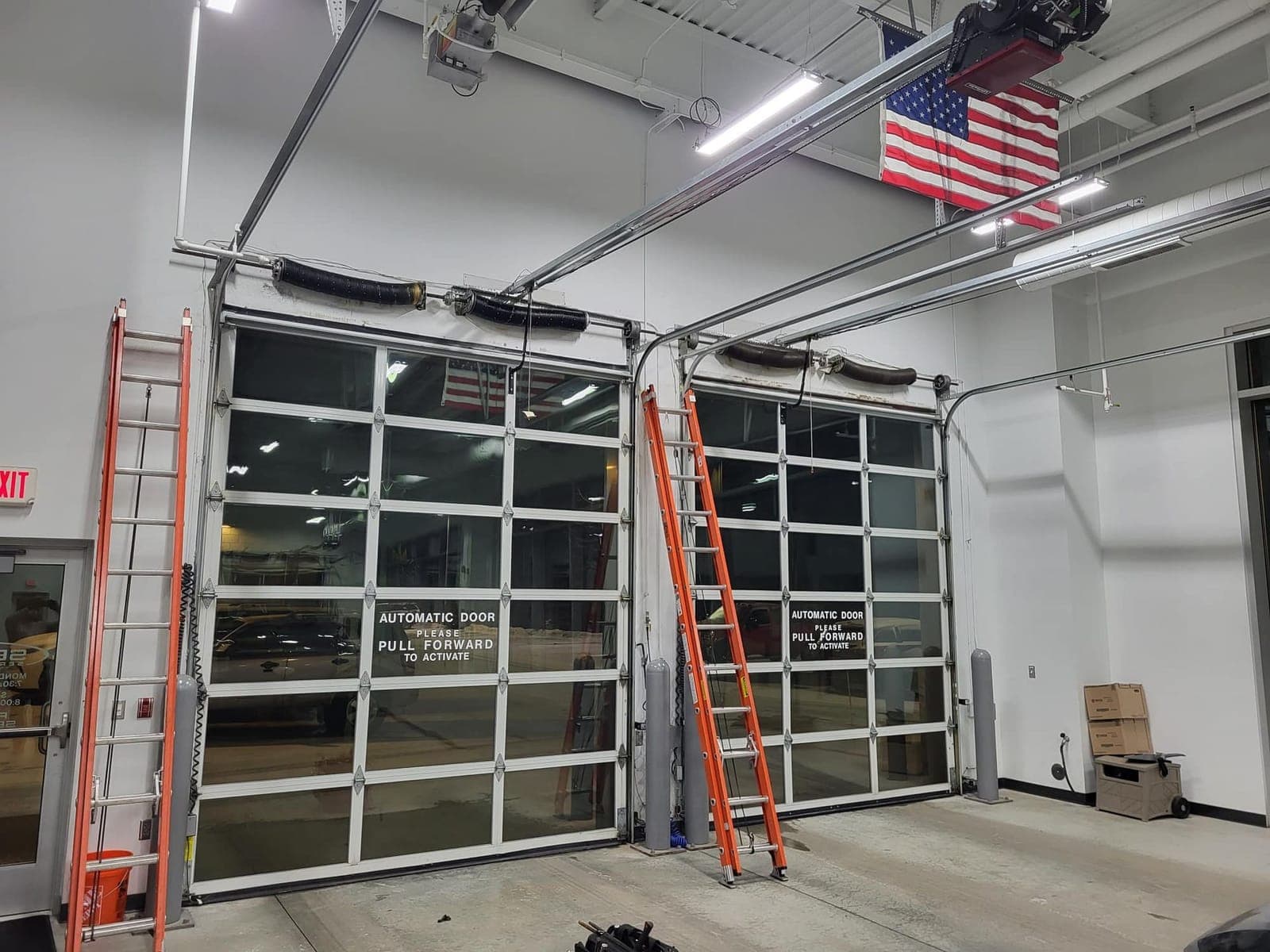
A commercial overhead door maintenance checklist splits the work in two. Staff look and listen every day for damage, frayed cables, loose hardware and blocked sensors. A trained technician handles springs, cables, operators and safety devices on a schedule. Clopay recommends inspection and lubrication quarterly or every 5,000 cycles, and LiftMaster sets operator service at the same interval.
Commercial door down or acting up?
Call the office · Mon to Fri · 7:30 am to 4:00 pm · Free estimates
What should a commercial overhead door maintenance checklist include
A useful checklist covers three things: what your own people look at, what a trained technician does and how often each one happens. Most checklists fail because they mix those together.
The intervals in the chart below come from the manufacturers and from DASMA, the Door & Access Systems Manufacturers Association. Where your door or operator manual says something different, follow the manual.
| Check | How often | Who |
|---|---|---|
| Door path clear of pallets, snow, ice and stored material | Every day | Staff |
| Door opens and closes fully without jerking, rubbing or new noise | Every day | Staff |
| Sections, track and seals looked over for fresh impact damage | Every week | Staff |
| Photo eyes clean, aligned and not blocked | Every week | Staff |
| Sensing edge and photo eyes tested per the operator manual | Monthly | Staff or technician |
| Springs, cables, rollers, hinges and hardware inspected for wear | Quarterly or every 5,000 cycles | Looked at by staff and serviced by a technician |
| Moving parts lubricated as the door maker directs | Quarterly or every 5,000 cycles | Technician |
| Operator serviced and its tests repeated | Every 3 months or 5,000 cycles | Technician |
| Door disconnected from the operator and checked for balance | Annually | Technician |
| Limits and clutch checked and safety devices retested | Annually | Technician |
| Rolling fire doors inspected and drop tested | Annually | Trained fire door technician |
What can your staff check every day and every week
Your staff can do everything that involves eyes and ears and nothing that involves tools. The people who run a door all day are the first to notice when it changes.
Walk each door in this order.
- 1Clear the openingMove pallets, carts, hoses, snow and ice out of the door's path and away from the tracks.
- 2Watch one full cycleRun the door all the way up and all the way down. It should travel evenly with both sides rising together and stop where it always has. Stand clear and never walk under a moving door.
- 3ListenGrinding, popping, scraping or an operator that sounds like it is straining are all new information. Write down which door and what you heard.
- 4Look at the sections and trackCheck for fresh dents, cracked or pulled hinges, bent track and rollers that have come out of the track.
- 5Look at the cables and springs from the floorLook for fraying on the lift cables and for a gap in a spring or heavy rust on it. DASMA's inspection guidance is blunt about this: visually inspect parts under spring tension and do not touch them.
- 6Check the photo eyes and the bottom edgeWipe the photo eye lenses, make sure nothing is stacked in front of them and look along the bottom seal or sensing edge for tears.
- 7Report it the same dayAnything on this list that looks different goes to whoever calls for service. A door that has been hit, hangs crooked or has a loose cable is taken out of use until it has been checked.
Which commercial door work is for a technician only
Anything involving springs, cables, bottom brackets, drums, the operator's internals or the adjustment of a safety device belongs to a trained technician.
Clopay's commercial door maintenance guidance warns that door springs, cables, brackets and other hardware attached to the springs are under very high tension and can cause serious injury or death if handled improperly, and that only a qualified professional should adjust them. It also says never to remove, adjust or loosen the fasteners on the bottom brackets, because those brackets are connected to the spring by the lift cable.
LiftMaster's Logic 5.0 commercial operator guide states that all maintenance must be performed by a trained door systems technician, with the power disconnected first.
- Springs: replacing, winding, adjusting and lubricating. This is spring repair.
- Lift cables, drums and bottom brackets: close inspection, replacement and resetting a cable that has come off its drum.
- Track and hardware: straightening or replacing bent track and replacing rollers and hinges.
- The operator: limits, clutch, belts, chains and wiring. That is operator repair.
- Safety devices: replacing or adjusting photo eyes and sensing edges.
- Balance: disconnecting a commercial door from its operator to check how it lifts. These doors weigh far more than anything on a house.
How often should a commercial overhead door be serviced
Quarterly is the manufacturers' baseline for a working commercial door, and a count of cycles can bring the visit sooner. A cycle is one trip up and one trip down.
Clopay recommends inspection and lubrication of a commercial sectional door quarterly or every 5,000 cycles, and an operation check once a year. In that yearly check the door is disconnected from the operator and run by hand to confirm it lifts smoothly and holds its position, then the limits and the safety devices are tested.
LiftMaster's schedule for the operator runs alongside. Its Logic 5.0 commercial operator guide says the operator should be serviced every 3 months or 5,000 cycles, every 6 months or 10,000 cycles and every 12 months or 20,000 cycles, and that all of the operator's tests should be repeated every 3 months or 5,000 cycles.
The cycle counts are what matter for a busy opening. A door that reaches 5,000 cycles well inside three months is due on the count, not the calendar. Tell us roughly how often each door runs and we will help you set a schedule that fits, which is what the planned service on our commercial garage doors page is for. Rolling doors have their own guidance, covered in our article on rolling steel door maintenance.
How do you test the safety devices on a commercial door
Test them the way the operator manual describes and on a regular schedule, because a sensing edge or photo eye only protects people if it still sends a signal. The manual for your operator is the authority on the exact test.
DASMA's Technical Data Sheet 368 on edge sensors explains the two kinds of system. In a monitored system the operator checks that the device is present and connected, and DASMA says to check and test the device for proper operation monthly. A non-monitored system cannot detect a fault in its own circuit, so DASMA says it is important to test activation regularly along the entire length of the edge.
If a test fails, stop there. DASMA's code inspection checklist notes that a commercial operator with neither photo eyes nor a sensing edge requires constant pressure on the button to close the door. Treat a door with a failed safety device the same way until a technician has repaired it: someone holds the button and watches the door all the way down.
Why do busy doors need high-cycle springs
Because every spring has a working life measured in cycles, and a busy door uses that life up quickly. A service bay or shipping door can open dozens of times before lunch.
High-cycle springs are made with heavier wire and longer bodies, so each spring works less on every cycle and lasts through far more trips up and down. If the springs on the same door keep breaking, the door is telling you the springs are too light for the work.
How the door is treated matters too. DASMA's Technical Data Sheet 190 lists the things that shorten spring life in service.
- Rust: DASMA says rust reduces the effective area of the spring wire and can cause corrosion pits from which fatigue cracks grow.
- Corrosive air: wash bays and similar spaces should be reviewed for corrosive effects on springs.
- Doors left open: in climates with extreme cold or frequent precipitation, DASMA says doors should be kept closed where possible.
- Added weight: paint or anything attached to the door can push its weight past what the springs were specified for.
- Skipped maintenance: DASMA says the counterbalance assembly should be maintained according to the door manufacturer's written instructions.
What maintenance records should you keep for each door
Keep one dated record per door that shows what was checked, what was found and what was done. A record turns a string of surprise breakdowns into a pattern you can plan around.
- A door list: each door's location, size, type and what drives it
- The door and operator manuals, or at least the make and model from the labels
- The cycle count, if your operator keeps one, noted at each service visit
- Each service visit: the date, who did the work, what was replaced and what was flagged as wearing
- Each impact: the date a door was hit, what hit it and when it was checked
- Staff reports: the noises, stalls and resets your people noticed between visits
How does a Northern Michigan winter wear on commercial doors
Winter here attacks the bottom of the door and everything near the floor. Traverse City often sees more than 100 inches of lake-effect snow in a season, and every loader, plow truck and forklift that comes through the opening carries salt and slush in with it.
That mix sits at the threshold. Meltwater runs under a worn bottom seal and freezes the door to the slab, and a commercial operator will pull hard on a frozen door before it gives up. Do not force it. Our guide to a garage door frozen to the ground covers how to free one without damage. Salt also sits on the bottom section, the bottom brackets and the lower ends of the cables.
Forklifts add the rest. DASMA's Technical Data Sheet 182 on dock doors notes that weather seals and jamb brackets are subject to impacts from vehicles such as forklifts passing through the opening, and that a door should be counterbalanced so it does not drift down into the opening where it can be hit.
We see this across Grand Traverse County. In Traverse City, commercial buildings run from Front Street out through Garfield Township, and many of their doors cycle all day. Grawn, at US-31 and Silver Lake Road, is in the same township as our shop, and open fields there let the wind pack drifts against a door. Kingsley, out M-113 in Paradise Township, is farm country with equipment buildings and big doors that take hits from tractors and trailers. And Kalkaska, where US-131 and M-72 cross, is far from the milder air along the bay, so winter there is long, cold and snowy.
What does a stuck door really cost a business
More than the repair. When a loading door jams or a bay door will not close, work stops, heat pours out and the building sits unsecured.
The repair is usually the small part. The larger cost is the truck that cannot be loaded, the bay that cannot take the next job, the crew standing around and the furnace running against an open hole in the wall in the middle of winter.
Planned maintenance moves that cost to a time you choose. A worn cable replaced on a scheduled visit takes one door out of service briefly on a slow morning. The same cable letting go on its own takes the door out with no warning. Our office is open Monday to Friday, 7:30 am to 4:00 pm, and closed on weekends, which is one more reason to catch wear on a scheduled visit and not on a Friday night.
When should you stop using a commercial door and call
Stop using the door the moment it looks or sounds wrong in a way that involves the springs, the cables or the track.
- A spring has broken or shows a visible gap
- A cable is frayed, slack or off its drum
- The door hangs crooked or one side leads the other
- The door has been hit by a truck or forklift
- A roller is out of the track or the track is bent
- The door drifts down or will not stay open
- The operator trips out, strains or needs to be reset again and again
- A photo eye or sensing edge no longer stops or reverses the door
Sources
- 1.Commercial Door Maintenance · Clopay
- 2.Logic 5.0 Commercial Door Operator User's Guide (Models T, APT, H, J, HJ, GH, GT, SD and GSD) · LiftMaster
- 3.Technical Data Sheet #190: Factors Affecting Spring Cycle Life · Door & Access Systems Manufacturers Association (DASMA)
- 4.Technical Data Sheet #368: Edge Sensors · DASMA
- 5.Technical Data Sheet #182: Technical Considerations for Dock Doors · DASMA
- 6.Technical Data Sheet #151: General Code Inspection Guidelines for Sectional Garage Doors · DASMA
Free estimate
Have our crew take a look
One short form and our office calls you back during business hours. Most repairs are finished on the first visit, and every truck rolls out stocked.
Or call the office(231) 360-5442Mon to Fri · 7:30 am to 4:00 pm · Closed weekends
Request service
About a minute. Our office calls you back.